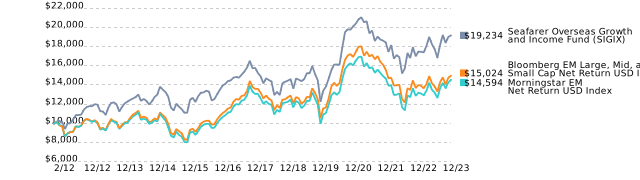
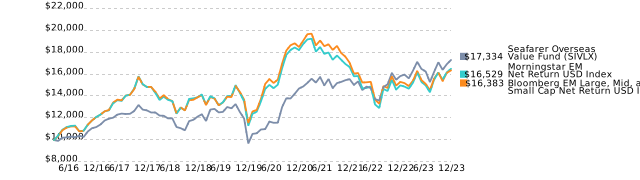
Overview
Investment Objective
The Fund seeks to provide long-term capital appreciation along with some current income; it also seeks to mitigate adverse volatility in returns.
Strategy
The Fund invests primarily in the securities of companies located in developing countries. The Fund invests in several asset classes including dividend-paying common stocks, preferred stocks, convertible bonds, and fixed-income securities.
The Fund seeks to offer investors a relatively stable means of participating in a portion of developing countries’ growth prospects, while providing some downside protection compared to a portfolio that invests only in the common stocks of those countries.
Share Classes
| Investor | Institutional | |
|---|---|---|
| Ticker | SFGIX |
SIGIX |
| CUSIP | 317609311 | 317609295 |
| NAV (5/20/13) | $12.15 | $12.16 |
| 30-Day SEC Yield (4/30/13) | 1.78% | 1.95% |
| Fund Distribution Yield | 0.95% | 1.04% |
| Net Expense Ratio1 | 1.40% | 1.25% |
| Load | None | None |
| 12b-1 Fee | None | None |
| Redemption Fee (within 90 calendar days) | 2.0% | 2.0% |
| Minimum Initial Investment | $2,500 | $100,000 |
| Minimum Initial Investment (Retirement Account) | $1,000 | $100,000 |
| Minimum Subsequent Investment | $500 | $500 |
Underlying Portfolio Holdings as of 3/31/13
| Number of Holdings | 46 |
| % of Net Assets in Top 10 Holdings | 38% |
| Weighted Average Market Cap | $11.0 B |
| Market Cap of Portfolio Median | $4.7 B |
| Gross Portfolio Yield2 | 3.0% |
| Price / Book Value2 | 1.8 |
| Price / Earnings2 | 14.5 |
| Earnings Per Share Growth2 | 10% |
- Gross expense ratio: 4.48% for Investor Class; 4.59% for Institutional Class1 All performance is in U.S. dollars with gross (pre-tax) dividends and/or distributions reinvested. The performance data quoted represents past performance and does not guarantee future results. Future returns may be lower or higher. The investment return and principal value will fluctuate so that an investor's shares, when redeemed, may be worth more or less than the original cost. Shares of the Fund redeemed or exchanged within 90 days of purchase are subject to a 2% redemption fee. Performance does not reflect this fee, which if deducted would reduce an individual's return.
Geographic Focus
Developing countries including, but not limited to:
- Brazil
- Chile
- China
- Colombia
- Czech Republic
- Egypt
- Hungary
- India
- Indonesia
- Malaysia
- Mexico
- Morocco
- Peru
- Philippines
- Poland
- South Africa
- South Korea
- Sri Lanka
- Taiwan
- Thailand
- Turkey
- Vietnam
Selected developed countries with significant economic and financial linkages to developing countries, including:
- Australia
- Hong Kong
- Ireland
- Israel
- Japan
- New Zealand
- Singapore
- United Kingdom
- Sources: ALPS Fund Services, Inc., FactSet Research Systems, Seafarer
- Portfolio holdings are subject to change.
- The "Underlying Portfolio Holdings" table above presents indicative values only; Seafarer does not warrant the data's accuracy, and disclaims any responsibility for its use for investment purposes.
- William Maeck and Kate Jaquet are Registered Representatives of ALPS Distributors, Inc.
- Seafarer Capital Partners, LLC (the “Adviser”) has agreed contractually to waive and/or reimburse fees or expenses in order to limit Total Annual Fund Operating Expenses After Fee Waiver / Expense Reimbursements (excluding acquired fund fees and expenses, brokerage expenses, interest expenses, taxes and extraordinary expenses) to 1.60% and 1.45% of the Fund’s average daily net assets for the Investor and Institutional share classes, respectively. This agreement is in effect through August 31, 2013. In addition to the Adviser’s agreement to contractually waive and/or reimburse fees or expenses, the Adviser has voluntarily agreed to waive a portion of its management fee payable by the Fund so that such fee is reduced to 0.75% of the Fund’s average daily net assets. Further, after giving effect to this voluntary agreement to waive a portion of its management fee, the Adviser has also agreed to voluntarily waive and/or reimburse fees or expenses of the Fund in order to limit total annual fund operating expenses (excluding acquired fund fees and expenses, brokerage expenses, interest expenses, taxes and extraordinary expenses) to 1.40% and 1.25% of the Fund’s average daily net assets for the Investor and Institutional share classes, respectively. The Adviser intends to continue these voluntary arrangements through at least August 31, 2013 (the date the existing contractual agreement expires), at which point they may be extended further. However, the Adviser may reduce or terminate these voluntary arrangements at any time without notice.
- Calculated as a harmonic average of the underlying portfolio holdings.
Performance
| Performance | NAV Contribution (SFGIX) |
|---|---|
Monthly Performance as of 4/30/13
| NAV / Index Level (4/30/13) |
Total Return | Total Return Since Inception |
Inception Date |
Net Expense Ratio1 |
|||||
|---|---|---|---|---|---|---|---|---|---|
| 1 Mo | 3 Mo | YTD | 1 Yr | Annualized | Cumulative | ||||
SFGIX (Investor Class) |
$11.91 | 1.79% | 2.58% | 5.03% | 18.24% | 16.62% | 20.37% | 2/15/12 | 1.40% |
SIGIX (Institutional Class) |
$11.91 | 1.79% | 2.58% | 5.03% | 18.33% | 16.70% | 20.46% | 2/15/12 | 1.25% |
| MSCI Emerging Markets Total Return Index2 |
1985.83 | 0.79% | –2.15% | –0.79% | 4.34% | 1.42% | 1.71% | n/a | n/a |
Quarterly Performance as of 3/31/13
| NAV / Index Level (3/31/13) |
Total Return | Total Return Since Inception |
Inception Date |
Net Expense Ratio1 |
|||||
|---|---|---|---|---|---|---|---|---|---|
| 1 Mo | 3 Mo | YTD | 1 Yr | Annualized | Cumulative | ||||
SFGIX (Investor Class) |
$11.70 | 0.00% | 3.17% | 3.17% | 14.91% | 16.09% | 18.24% | 2/15/12 | 1.40% |
SIGIX (Institutional Class) |
$11.70 | 0.00% | 3.17% | 3.17% | 14.89% | 16.17% | 18.34% | 2/15/12 | 1.25% |
| MSCI Emerging Markets Total Return Index2 |
1970.21 | –1.70% | –1.57% | –1.57% | 2.30% | 0.81% | 0.91% | n/a | n/a |
- Gross expense ratio: 4.48% for Investor Class; 4.59% for Institutional Class1 All performance is in U.S. dollars with gross (pre-tax) dividends and/or distributions reinvested. The performance data quoted represents past performance and does not guarantee future results. Future returns may be lower or higher. The investment return and principal value will fluctuate so that an investor's shares, when redeemed, may be worth more or less than the original cost. Shares of the Fund redeemed or exchanged within 90 days of purchase are subject to a 2% redemption fee. Performance does not reflect this fee, which if deducted would reduce an individual's return.
- Source: ALPS Fund Services, Inc.
- Sources: Bloomberg, Seafarer
- The NAV Contribution charts present indicative values only; Seafarer does not warrant the data's accuracy, and disclaims any responsibility for its use for investment purposes.
- Seafarer Capital Partners, LLC (the “Adviser”) has agreed contractually to waive and/or reimburse fees or expenses in order to limit Total Annual Fund Operating Expenses After Fee Waiver / Expense Reimbursements (excluding acquired fund fees and expenses, brokerage expenses, interest expenses, taxes and extraordinary expenses) to 1.60% and 1.45% of the Fund’s average daily net assets for the Investor and Institutional share classes, respectively. This agreement is in effect through August 31, 2013. In addition to the Adviser’s agreement to contractually waive and/or reimburse fees or expenses, the Adviser has voluntarily agreed to waive a portion of its management fee payable by the Fund so that such fee is reduced to 0.75% of the Fund’s average daily net assets. Further, after giving effect to this voluntary agreement to waive a portion of its management fee, the Adviser has also agreed to voluntarily waive and/or reimburse fees or expenses of the Fund in order to limit total annual fund operating expenses (excluding acquired fund fees and expenses, brokerage expenses, interest expenses, taxes and extraordinary expenses) to 1.40% and 1.25% of the Fund’s average daily net assets for the Investor and Institutional share classes, respectively. The Adviser intends to continue these voluntary arrangements through at least August 31, 2013 (the date the existing contractual agreement expires), at which point they may be extended further. However, the Adviser may reduce or terminate these voluntary arrangements at any time without notice.
- The MSCI Emerging Markets Total Return Index, Standard (Large+Mid Cap) Core, Gross (dividends reinvested), USD is a free float-adjusted market capitalization index designed to measure equity market performance of emerging markets. The MSCI Emerging Markets Total Return Index consists of the following 21 emerging market country indices: Brazil, Chile, China, Colombia, Czech Republic, Egypt, Hungary, India, Indonesia, Korea, Malaysia, Mexico, Morocco, Peru, Philippines, Poland, Russia, South Africa, Taiwan, Thailand, and Turkey. Index code: GDUEEGF. It is not possible to invest directly in this or any index.
Composition
| Holdings | Portfolio Composition |
|---|---|
Top 10 Holdings as of 3/31/13
| Holding | Sector | Country | Issuer Mkt Cap ($B) | Yield1 | Price/ Book | Price/ Earnings2 | EPS Growth2 |
|---|---|---|---|---|---|---|---|
| SIA Engineering Co., Ltd. | Industrials | Singapore | $4.2 | 4.6% | 4.3 | 19 | 5% |
| PGE Polska Grupa Energetyczna SA | Utilities | Poland | $9.6 | 5.1% | 0.8 | 11 | -3% |
| Sindoh Co. Ltd. | Information Technology | South Korea | $0.6 | 3.8% | 0.8 | – | – |
| Ajinomoto Co. Inc | Consumer Staples | Japan | $9.3 | 1.1% | 1.5 | 19 | 1% |
| Aselsan Elektronik Sanayi Ve Ticaret AS | Industrials | Turkey | $2.9 | 1.5% | 4.2 | 15 | 12% |
| Bangkok Bank PCL NVDR | Financials | Thailand | $14.5 | 2.9% | 1.6 | 11 | 13% |
| Bank Pekao SA | Financials | Poland | $12.7 | 3.4% | 1.8 | 15 | 10% |
| Infosys, Ltd. ADR | Information Technology | India | $30.5 | 1.2% | 4.5 | 18 | 9% |
| Hang Lung Properties, Ltd. | Financials | China / Hong Kong | $16.7 | 2.6% | 1.1 | 20 | 16% |
| Sociedad Quimica y Minera de Chile SA ADR | Materials | Chile | $14.4 | 1.8% | 6.3 | 21 | 11% |
|
38%
46
|
|||||||
Portfolio holdings are subject to change.
Sources: ALPS Fund Services, Inc., FactSet Research Systems, Seafarer
Portfolio Composition by Region as of 3/31/13
| All Holdings, Excluding Cash | ADRs, Common & Preferred Equities Only | |||||||||
|---|---|---|---|---|---|---|---|---|---|---|
| Price / Earnings4 | EPS Growth4 | |||||||||
| Region/Country | # of Holdings | % Net Assets | Avg Mkt Cap ($B)3 | Gross Yield4 | Price / Book4 | Prior Year | This Year | Next Year | This Year | Next Year |
| Investment Portfolio | 46 | 99% | $11.0 | 3.0% | 1.8 | 16 | 14 | 12 | 10% | 19% |
| East & South Asia | 32 | 66% | $11.0 | 3.1% | 1.8 | 16 | 14 | 11 | 10% | 24% |
| China / Hong Kong | 9 | 15% | ||||||||
| India | 1 | 3% | ||||||||
| Indonesia | 1 | 3% | ||||||||
| Japan | 2 | 6% | ||||||||
| Malaysia | 3 | 5% | ||||||||
| Singapore | 5 | 11% | ||||||||
| South Korea | 3 | 8% | ||||||||
| Taiwan | 2 | 4% | ||||||||
| Thailand | 3 | 8% | ||||||||
| Vietnam | 3 | 3% | ||||||||
| Eastern Europe | 4 | 14% | $7.1 | 3.8% | 1.2 | 12 | 12 | 12 | -4% | 3% |
| Poland | 3 | 10% | ||||||||
| Turkey | 1 | 4% | ||||||||
| Latin America | 8 | 17% | $15.0 | 2.3% | 3.3 | 24 | 18 | 16 | 34% | 13% |
| Brazil | 3 | 7% | ||||||||
| Chile | 3 | 5% | ||||||||
| Mexico | 2 | 5% | ||||||||
| Middle East & Africa | 2 | 2% | $4.3 | 3.8% | 9.1 | 24 | 20 | 18 | 18% | 16% |
| South Africa | 2 | 2% | ||||||||
| Cash and Other Assets, Less Liabilities | – | 1% | – | – | – | – | – | – | – | – |
Sources: ALPS Fund Services, Inc., FactSet Research Systems, Seafarer
Portfolio Composition by Sector as of 3/31/13
| All Holdings, Excluding Cash | ADRs, Common & Preferred Equities Only | |||||||||
|---|---|---|---|---|---|---|---|---|---|---|
| Price / Earnings4 | EPS Growth4 | |||||||||
| Sector | # of Holdings | % Net Assets5 | Avg Mkt Cap ($B)3 | Gross Yield4 | Price / Book4 | Prior Year | This Year | Next Year | This Year | Next Year |
| Investment Portfolio | 46 | 99% | $11.0 | 3.0% | 1.8 | 16 | 14 | 12 | 10% | 19% |
| Consumer Discretionary | 2 | 3% | $3.8 | 4.6% | 3.6 | 15 | 14 | 14 | 7% | 6% |
| Consumer Staples | 5 | 12% | $6.3 | 2.3% | 2.8 | 22 | 22 | 21 | 0% | 7% |
| Energy | 3 | 7% | $16.2 | 4.0% | 1.4 | 9 | 7 | 6 | 34% | 10% |
| Financials | 11 | 23% | $8.4 | 2.8% | 1.3 | 18 | 16 | 11 | 11% | 51% |
| Health Care | 6 | 10% | $3.1 | 2.4% | 4.5 | 16 | 21 | 18 | -24% | 14% |
| Industrials | 7 | 13% | $5.9 | 3.2% | 3.6 | 17 | 16 | 15 | 4% | 8% |
| Information Technology | 6 | 16% | $19.6 | 3.2% | 1.7 | 17 | 14 | 12 | 25% | 12% |
| Materials | 3 | 7% | $30.5 | 2.9% | 2.2 | 19 | 13 | 12 | 49% | 5% |
| Telecommunication Services | 1 | 2% | $0.9 | 3.3% | 2.0 | 15 | 11 | 8 | 33% | 38% |
| Utilities | 2 | 7% | $11.6 | 4.1% | 1.2 | 11 | 13 | 13 | -9% | 0% |
| Cash and Other Assets, Less Liabilities | – | 1% | – | – | – | – | – | – | – | – |
Sources: ALPS Fund Services, Inc., FactSet Research Systems, Seafarer
30-Day SEC Yield:
SFGIX 1.78%;
SIGIX 1.95%
(4/30/13)
The performance data quoted represents past performance and does not guarantee future results. Future returns may be lower or higher. The investment return and principal value will fluctuate so that an investor's shares, when redeemed, may be worth more or less than the original cost.
View the Fund’s most recent month-end performance.
Portfolio Composition by Asset Class as of 3/31/13
| Asset Class | % Net Assets |
|---|---|
| Common Stock | 84% |
| ADR | 7% |
| Preferred Stock | 6% |
| USD Convertible Bond | 1% |
| Foreign Currency Convertible Bond | 1% |
| Cash and Other Assets, Less Liabilities | 1% |
| Total | 100% |
Source: ALPS Fund Services, Inc.
Portfolio Composition by Market Capitalization as of 3/31/13
| Market Capitalization of Issuer | % Net Assets |
|---|---|
| Large Cap (over $10 billion) | 31% |
| Mid Cap ($1 - $10 billion) | 52% |
| Small Cap (under $1 billion) | 16% |
| n/a | 1% |
| Total | 100% |
Sources: ALPS Fund Services, Inc., Seafarer
The tables and charts above present indicative values only; Seafarer does not warrant the data's accuracy, and disclaims any responsibility for its use for investment purposes. Percentage values may not sum to 100% due to rounding.
- Yield = dividend yield for common and preferred stocks and yield to maturity for bonds
- Sindoh Co. Ltd., a small capitalization company located in South Korea, is not followed by enough brokerage analysts so as to have public “consensus” forecasts for its earnings or EPS growth.
- Weighted Average Market Capitalization of Issuer
- Calculated as a harmonic average of the underlying portfolio holdings.
- The Fund’s concentration in the Financials sector includes holdings in property-related stocks, which are classified within the “Financials sector” according to the Global Industry Classification Standard (GICS) methodology utilized herein. Property-related holdings comprised 5% of the Fund’s net assets as of 3/31/13.
Distributions
Estimates for the Seafarer Fund’s mid-year distributions will be available on this page the week of June 10, 2013. Dates for the distributions are provided below.
Projected 2013 Distribution Dates
Please note: These dates are subject to change.
| Record Date | Ex, Pay and Reinvest Date |
|
|---|---|---|
| First Semi-annual | 6/26/13 | 6/27/13 |
| Second Semi-annual | 12/10/13 | 12/11/13 |
To be notified of distribution estimates, please sign up to receive Seafarer news in the Stay Updated box at right.
Historical Distributions
SFGIX (Investor Class)
| Ex, Pay and Reinvest Date | Reinvest NAV | Ordinary Income | Short Term Capital Gains | Long Term Capital Gains | Total Distrib. Per Share | Cumulative Distrib. Per Share Since Inception |
|---|---|---|---|---|---|---|
| 12/12/12 | $11.14 | $0.06027 | $0.00053 | $0.00000 | $0.06080 | $0.11075 |
| 6/28/12 | $9.71 | $0.04995 | $0.00000 | $0.00000 | $0.04995 | $0.04995 |
SIGIX (Institutional Class)
| Ex, Pay and Reinvest Date | Reinvest NAV | Ordinary Income | Short Term Capital Gains | Long Term Capital Gains | Total Distrib. Per Share | Cumulative Distrib. Per Share Since Inception |
|---|---|---|---|---|---|---|
| 12/12/12 | $11.14 | $0.08657 | $0.00053 | $0.00000 | $0.08710 | $0.12194 |
| 6/28/12 | $9.73 | $0.03484 | $0.00000 | $0.00000 | $0.03484 | $0.03484 |
For more information on the Fund's distribution policies, please see the “Dividends and Distributions” section of the Prospectus.
Should you have any questions, please contact Shareholder Services at (855) 732-9220 (Mon–Fri 9am–8pm ET).
Past performance is no guarantee of future results. There is no guarantee that the Fund will pay or continue to pay distributions.
Portfolio Review
Portfolio Review – First Quarter 2013
During the first calendar quarter of 2013, the Seafarer Overseas Growth and Income Fund gained 3.17% for both the Investor and Institutional classes, while the Fund’s benchmark, the MSCI Emerging Markets Total Return Index, fell -1.57%. By way of broader comparison, the S&P 500 Index rose 10.61%.
Performance
So far, 2013 has proven to be a tumultuous year for stocks in the developing world. Despite an auspicious start to the year – emerging markets surged in early January – by the end of the quarter, the markets had reversed and were in decline. This reversal occurred despite impressive gains from U.S. equities during the same period. Investors in the emerging markets have long hoped their performance would “decouple” from the developed world; unfortunately, decoupling was all too evident during the quarter, but not in a manner that was beneficial to short-run returns.
There are competing explanations as to why emerging markets performed so poorly. The list includes weak growth in China; a sharp, cyclical decline in commodity markets; major shifts in economic policy in Brazil; and elevated inflation in some of the largest markets, such as China, India and Brazil. However, in my view, the most important causal factor was identified in Seafarer’s semi-annual shareholder letter last fall, and again in our shareholder conference call in January: namely, that growth in corporate profits was likely to fall below the market’s elevated (and misplaced) expectations. As of late February, Bloomberg News reported that over 60% of the companies tracked within the MSCI Emerging Markets Index (the Fund’s benchmark) reported fourth quarter results that fell short of forecasts.1 I am convinced that the resulting disappointment was directly responsible for the volatility and poor performance that ensued. The same report stated that the equivalent ratio for the MSCI World Index – which includes most developed markets – was just over 30%, suggesting growth in the developed world was far more resilient.
Against this rocky backdrop, the Fund performed reasonably well; I am pleased the portfolio produced gains, even as emerging markets broadly declined. Even so, it was a bruising quarter, and the Fund did not go unscathed. Several of the portfolio’s largest positions – including SIA Engineering, PGE, Ajinomoto, and SQM – reported results that the market perceived as being weak, and those companies’ share prices retreated as a result. Despite short-term setbacks for these four stocks, I remain enthused about the long-term prospects for each, and I believe the market’s response was exaggerated and will ultimately prove misplaced.
The Fund’s outsized allocation to Polish stocks also weighed on performance. The economy there has recently stagnated, with near 0% growth, falling well below forecasts that called for a 2.5% expansion. This unexpected downturn triggered a decline in Polish stocks and the local currency (the zloty). The end result was that Poland finished the first quarter of as one of the worst-performing emerging markets in the world – and unfortunately, the Fund’s three Polish holdings fell in tandem with the market. Yet the valuations for each of these positions (PGE, Bank Pekao and Asseco) are ever more compelling, their cash flows attractive, and their long-term growth prospects undiminished, despite the tepid economic backdrop at present. Nonetheless, I will be travelling to Poland shortly to revisit my assumptions for each of these holdings.
Offsetting these challenges, a number of the Fund’s mid-sized positions performed very well. For example, the portfolio’s two holdings in Mexico (Kimberly Clark and Grupo Herdez) both produced strong gains. Both are makers of consumer products – diapers and sauces respectively – and both are benefiting from strong growth in Mexico that has translated to vigorous spending by consumers. Also, the local currency (the peso) has gained steadily as of late, and this has been beneficial to both companies’ profits, as it has reduced the effective costs of some of their key inputs, which happen to be denominated in dollars.
The Fund’s holdings in Southeast Asia also made notable contributions to the Fund’s gains. The Fund’s Vietnam positions fared well because of their underlying profitability: financial results from the past quarter were reasonably good. At the same time, the Vietnamese government restored a degree of confidence to the market by announcing a series of important economic reforms, and this has boosted shares broadly. However, the government has yet to execute its various initiatives, and if it does not do so reasonably soon, frustration is likely to resurface. Meanwhile, the Fund’s two positions in the Thai financial sector (Bangkok Bank and Thai Reinsurance) also performed well. Both companies ostensibly benefitted from resilient growth in Thailand; and the latter also saw its shares rise because investors determined that the company made sufficient repairs to its balance sheet following Thailand’s flood of 2011.
Allocation
As I survey global stock markets, it seems to me that a number of dramatic shifts are underway. This is an obvious truism: markets are never constant, and change is always at work. Yet at this moment, the shifts strike me as of being of greater magnitude and consequence than is usually the case.
One notable shift is that within the emerging markets, the commodities / materials sector has grossly underperformed most other sectors since the fall of 2011. At that time, markets around the world were under strain due to fears over the sustainability of the Eurozone, and shares in all sectors were depressed. However, by early 2012, most developed and emerging markets staged a partial recovery; but not so for emerging market commodity stocks, which remained depressed throughout the year. Early performance in 2013 has only sustained this trend: growth in China has decelerated, and commodity stocks everywhere have swooned in sympathy, even as other sectors have held up reasonably well.
I cannot yet explain this disconnect between commodities and the rest – Seafarer is currently researching the issue – but I find it intriguing, because for the better part of the past decade, investors bought commodity stocks aggressively as a means to “play” growth in the emerging world. The sector was previously considered to be “high beta”: if emerging markets were set to perform well, investors reflexively assumed commodities would perform all the better. That strategy is now on the rocks. In the past, I have shunned such businesses because I have not been able to make sense of the elevated valuations that investors have placed on their shares. I find it difficult to value businesses that are so deeply cyclical and volatile.
Yet now that valuations have receded so sharply, I believe that value is emerging. As a consequence, the Fund is adding to its exposure to commodities, albeit cautiously and in a very focused manner. To be sure, the Fund remains underweight the materials sector, with a 7% weighting versus 11% in the benchmark index. (Note: non-energy-related commodity businesses are classified as “materials” by the benchmark index.) Further still, I believe the stated 7% allocation for the Fund overstates its true exposure to commodities: the Fund holds only two stocks that are “pure” commodities companies (SQM and Vale, a new holding), both of which are focused on extraction of raw materials. Those two names together account for 5% of the Fund’s 7% allocation.2 The Fund’s modest allocation to extraction-based businesses is nevertheless the highest weighting I have ever placed on the sector in my career. To date, it has been the wrong bet: both SQM and Vale have detracted from performance, in line with the sector overall. Yet I am optimistic about the valuations of these two stocks, and despite their cyclicality, I believe both might deliver the sort of long-term sustainable growth that the Fund seeks.
Another major change in global markets is the drastic shift in monetary policy now underway in Japan. As I discussed in greater depth in my Tokyo Field Notes, I am deeply divided about what is occurring in Japan. On the one hand, I firmly believe that aggressive monetary policy is the correct prescription for what ails the country most: deflation. On the other hand, I think there is a material chance that Japan’s monetary policies will stoke intense speculation in a narrow group of financial assets. Indeed I believe a number of “mini-bubbles” are already forming, with distorted valuations evident for certain stocks and REITs (real estate investment trusts). If those mini-bubbles burst violently, I fear Japan’s new monetary policies will be discredited and withdrawn before they can induce needed change. If that happens, all the major policy options I can envision for the country will be exhausted. Thus there is a certain “go-for-broke” quality to the new policy construct that leaves little room for error. The Fund remains invested in Japan for the time being because of the individual merits of its holdings there; yet I am wary over what is likely to be a very wild ride.
Lastly, the deceleration in China’s growth rate has created yet another notable shift in global markets. I have commented at length about the causes and consequences of the deceleration, so I will not revisit the issue here.3 However, I note that within the span of three months, market sentiment has shifted sharply toward the negative. In the early weeks of 2013, emerging markets were ebullient; there was great hope that China’s growth would accelerate and cause an expansion in corporate profits. Now the pendulum has swung the other way – too far in my view – and valuations in some of the larger emerging markets have grown more attractive (especially in China). As a consequence, the Fund has established new positions within China whose depressed valuations seem at odds with their long-term growth prospects.
Andrew Foster Seafarer Capital Partners, LLC- The performance data quoted represents past performance and does not guarantee future results. Future returns may be lower or higher. The investment return and principal value will fluctuate so that an investor's shares, when redeemed, may be worth more or less than the original cost. View the Fund’s most recent month-end performance.
- The MSCI Emerging Markets Total Return Index, Standard (Large+Mid Cap) Core, Gross (dividends reinvested), USD is a free float-adjusted market capitalization index designed to measure equity market performance of emerging markets. The MSCI Emerging Markets Total Return Index consists of the following 21 emerging market country indices: Brazil, Chile, China, Colombia, Czech Republic, Egypt, Hungary, India, Indonesia, Korea, Malaysia, Mexico, Morocco, Peru, Philippines, Poland, Russia, South Africa, Taiwan, Thailand, and Turkey. Index code: GDUEEGF. It is not possible to invest directly in this or any index.
- The views and information discussed in this commentary are as of the date of publication, are subject to change, and may not reflect the writer's current views. The views expressed represent an assessment of market conditions at a specific point in time, are opinions only and should not be relied upon as investment advice regarding a particular investment or markets in general. Such information does not constitute a recommendation to buy or sell specific securities or investment vehicles. It should not be assumed that any investment will be profitable or will equal the performance of the portfolios or any securities or any sectors mentioned herein. The subject matter contained herein has been derived from several sources believed to be reliable and accurate at the time of compilation. Seafarer does not accept any liability for losses either direct or consequential caused by the use of this information.
- As of 12/31/2012, SIA Engineering Co., Ltd. comprised 4.9% of the Seafarer Overseas Growth and Income Fund; PGE Polska Grupa Energetyczna SA comprised 4.7% of the Fund; Ajinomoto Co. Inc. comprised 3.2% of the Fund; SQM (Sociedad Quimica y Minera de Chile SA ADR) comprised 2.6% of the Fund; Bank Pekao SA comprised 3.2% of the Fund; Asseco Poland SA comprised 2.4% of the Fund; Kimberly-Clark de Mexico SAB de CV comprised 2.3% of the Fund; Grupo Herdez SAB de CV comprised 2.2% of the Fund; Bangkok Bank PCL comprised 3.0% of the Fund; Thai Reinsurance PCL comprised 1.4% of the Fund; and Taiwan Hon Chuan Enterprise Co., Ltd. comprised 1.4% of the Fund. As of 12/31/2012, the Fund had no economic interest in Vale (Cia Vale do Rio Doce, Pfd.). View the Seafarer Overseas Growth and Income Fund’s Top 10 Holdings. Holdings are subject to change.
- Bloomberg News, “Emerging Stocks Cheapen as Profits Disappoint,” 24 February 2013.
- The other 2% of the 7% in the materials sector is attributable to Taiwan Hon Chuan (THC), a producer of plastic bottles for the Asian beverage industry. THC produces plastics, and thus it is officially classified as a “materials” stock. However, I think that designation is debatable. Most companies in the materials sector produce highly commoditized products. By contrast, THC produces very specialized bottles and packaging, designed for consumer use. Its customers are bottlers, and THC is often highly integrated with its clientele, with production lines embedded within its clients’ premises. I think these features distinguish THC’s business from generic plastics companies, and as a consequence I personally believe the company is economically aligned with the consumer staples sector.
- For more information on this topic, please see the following commentaries and presentations: Letter to Shareholders (Annual Report for the period ended April 30, 2012), Inaugural Shareholder Conference Call (July 2012), Letter to Shareholders (Semi-Annual Report for the period ended October 31, 2012).
![[Chrome]](/_layout/images/chrome.png)
![[Firefox]](/_layout/images/firefox.png)
![[Opera]](/_layout/images/opera.png)
![[Internet Explorer]](/_layout/images/iexplore.png)