- China is facing significant government budget pressures stemming from a slowing economy and the collapse of land sale revenues.
- Beijing has implemented changes that require state firms to pay out higher profits and direct more of those profits away from the state sector and into the government budget.
- These reforms will substantially reduce an implicit subsidy to state firms and may force them to operate more efficiently.
Prevailing Winds is a China-focused blog written by Nicholas Borst, Vice President and Director of China Research at Seafarer. The blog tracks the economic and financial developments shaping the world’s largest emerging market.
Chinese state-owned enterprises (SOEs) are among the largest companies in the world and wield outsized influence across many industries. The country’s large SOE groups preside over sprawling corporate empires, including publicly listed subsidiaries that continue to play a significant role in China’s equity markets. In 2025, SOEs generated $12.5 trillion in revenue and $596 billion in profits.1
How China manages these enterprises is therefore tremendously important, and it is clear that a change is now underway. Beijing has implemented substantially higher profit remittance requirements for SOEs. Following these new policies, profit remittances from central SOEs increased by nearly 79%.2
Perhaps more importantly, instead of being recycled back into other SOEs, these profits are increasingly flowing directly into the government budget. Taken together with higher remittances, this marks a shift in how the Chinese government manages its state firms. The financial safety net of low dividends and ongoing subsidies that has allowed SOEs to operate inefficiently for decades is being removed. This could trigger a sea change in how SOEs are run, with major ramifications for the Chinese economy.
Budget Crunch
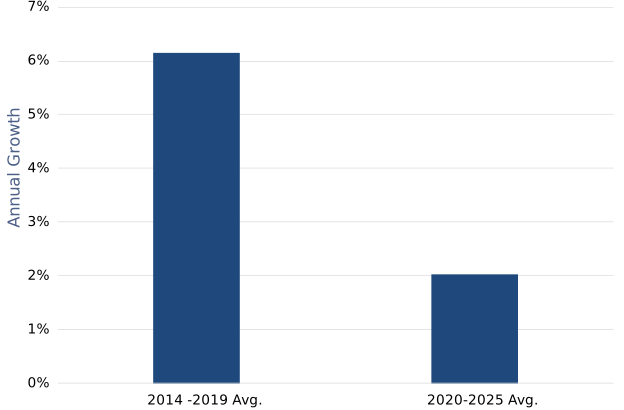
The decision to raise payout ratios for SOEs is the result of financial pressure on China’s government. Fiscal revenues are being squeezed by the economic slowdown, the collapse of land sale revenues, and tax and fee reductions implemented over the past several years to boost the economy. As shown in Figure 1, China’s tax revenue growth rate has slowed significantly relative to the recent past.
- Sources: China Ministry of Finance; Seafarer.
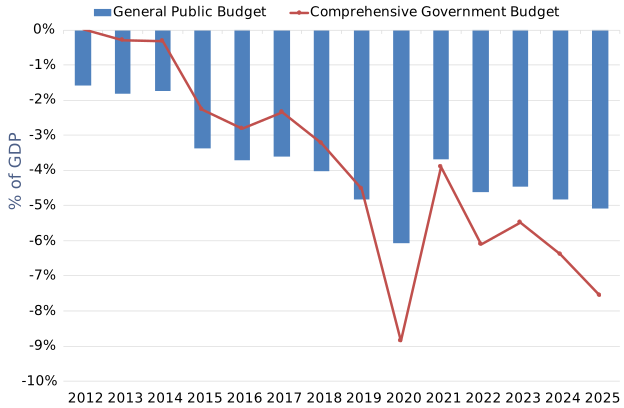
The budget pressure from the slowdown in revenue growth is exacerbated by rising expenditures and mounting financial liabilities. As represented by blue bars in Figure 2, China’s general government budget deficit in 2025 exceeds 5% of gross domestic product (GDP). This is the highest level since 2020, when pandemic-related spending pushed the deficit to a record high. That figure rises further when the government’s other budgets are included. The Chinese government maintains four budgets: the general public budget, the government fund budget (closely tied to land sales), the state capital operations budget (which collects profits from SOEs), and the social insurance fund budget. The consolidated deficit (red line in Figure 2) across these budgets exceeds 7.5% of GDP.
- Source: Wind Information.
Faced with these financial pressures, it is little wonder that Beijing is looking for additional revenue. Forcing SOEs to pay higher profits and directing those profits toward the government budget is an obvious way to help plug the widening hole in the budget.
Time to Pay Up
In March 2026, the Ministry of Finance announced new profit remittance rates for central SOEs. The remittance tiers increased substantially, with the top rate for profit remittances growing from 25% to 35%. This represents one of the most significant changes to SOE governance in more than a decade. Figure 3 shows the progression of SOE payout ratios over the past 20 years. Starting from extremely low levels in 2007, the top payout has more than tripled for SOEs in certain industries.
| Year | Profit Remittance Tiers |
| 2007 | 0%, 5%, 10% |
| 2010 | 0%, 5%, 10%, 15% |
| 2014 | 0%, 10%, 15%, 20%, 25% |
| 2026 | 0%, 20%, 30%, 35% |
- Sources: China Ministry of Finance; Seafarer.3
Figure 4 shows the distribution of profit remittance tiers by industry. As the figure shows, Beijing is extracting the highest remittances from industries where SOEs generate large profits from monopolies or quasi-monopolies, such as tobacco and telecommunications.
In contrast, more strategic SOEs, such as military or research enterprises, cultural enterprises, or those focused on fulfilling policy goals, are subject to the lowest rates. The differentiation by industry clearly reflects that Beijing is more comfortable siphoning a higher share of profits from industries with entrenched market positions and large recurring cash flows.
| Industries | Rate |
| Tobacco enterprises and resource-type enterprises including petroleum & petrochemicals, electricity, telecommunications, and coal | 35% |
| Non-ferrous and ferrous metallurgical mining/smelting, transportation, electronics, trade, construction, and other general competitive enterprises | 30% |
| Military industry enterprises, restructured research institutes, China Post Group, China State Railway Group, Beidahuang Land Reclamation Group, central cultural enterprises, and enterprises under central departments | 20% |
| Policy-oriented enterprises and small and micro SOEs with payable profit under 100,000 renminbi | 0% |
- Source: China Ministry of Finance. 4
Seizing the Profits
Profits paid by SOEs to the government flow into the state capital operations budget, not directly into the general public budget. This is a crucial distinction and a root cause of many of the major distortions in the Chinese economy. The reason this is so important is that, historically, Beijing has recycled most of the funds paid by profitable SOEs back into the state sector, often through capital injections, restructuring support, and subsidies. These expenditures have served as a lifeline for inefficient firms and spared poorly run SOEs that might otherwise have gone bankrupt.
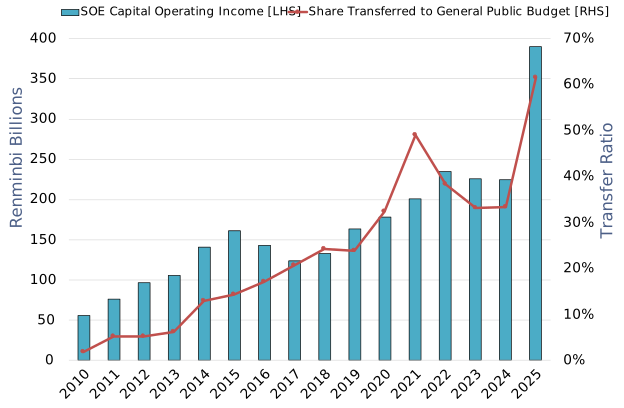
Financial pressure is now leading Beijing to direct a much higher proportion of central SOE funds into the general public budget. As shown in Figure 5, in 2025 around 60% of these funds were transferred to the general public budget, up from around 40% in recent years and far above the rates seen during the 2010s. This means a smaller portion of the funds is being recycled back into other SOEs. Local governments are pursuing this strategy even more aggressively, with the transfer ratio (for local SOE funds directed into local government budgets) in 2025 exceeding 71%.5
- Sources: China Ministry of Finance; Seafarer.
The Big Picture
Beijing’s recent policy shifts to force SOEs to pay more and direct more of those profits to the budget are important. China’s state sector looms large within the economy, and the way Beijing manages it has a significant impact on the country’s growth rate and the distortions within the economy.
To understand the significance of this change, we first need to map out the problems stemming from China’s historical approach to managing SOEs. First, for many years, SOEs have paid out little to no profits. In contrast, private companies often face pressure from their owners to distribute earnings. This pressure to pay dividends acts as a source of financial discipline, forcing managers to focus on profitability and deploy capital efficiently. Chinese SOE managers, however, have been shielded from this pressure. As a result, many SOEs invest lavishly in projects with little regard for economic feasibility.
Second, as mentioned above, many of the profits that SOEs pay to the state are recycled back into supporting the least efficient SOEs. This creates a further distortion whereby poorly performing SOEs can avoid bankruptcy through government support. Inefficient state firms remain in industries longer than they should, fueling overcapacity and capital misallocation across many industries.
Third, although in theory state firms are owned collectively by the Chinese people, only a small share of their profits makes its way back to Chinese households.6 In most countries, corporate earnings ultimately flow to households through dividends, capital gains, and pension fund holdings, thereby supporting household consumption. In China, earnings from SOEs go to the government rather than directly to households. These earnings could ultimately benefit households through social spending or tax reductions.
As discussed above, China has historically recycled most SOE profits back into the state sector. As a result, household income in China is lower than it would otherwise be, which partially explains why Chinese household consumption is so low. The current shift toward the general budget creates an opportunity to reverse this trend, but only if those profits are channeled into social spending rather than used merely to reduce the deficit. Some economists have argued for an even more direct approach. One Chinese economist has proposed transferring ownership stakes in SOEs to households via state investment funds, allowing dividends to flow directly to the Chinese people.7
Forced by Necessity
China has a history of implementing economic reforms when circumstances demand them, rather than proactively pursuing reforms for their own sake. For example, the sweeping restructuring of the state sector in the late 1990s and early 2000s was brought about by widespread SOE insolvencies that threatened the financial stability of the country’s banks.
The economic challenges of today appear to be similarly driving Beijing to embrace new reforms. Growing budget constraints are forcing Beijing to seek new revenues, with SOEs now being a major target. Higher profit remittance targets and a smaller share of those profits being returned to SOEs will require them to change how they operate. The government is starting to remove the financial safety blanket that has allowed many SOEs to operate inefficiently for decades.
This could ultimately translate into substantial benefits for the Chinese economy. The state sector remains a major drag on China’s productivity and a source of economic distortions. While opening up more industries to private competition might be the ideal solution in theory, forcing SOEs to operate more efficiently is a second-best solution that is more feasible in China’s current political environment.
As with any medicine, the right dose must be administered. Many Chinese SOEs are financially weak, and a sharp reduction in support from the state capital operations budget could be enough to push parts of the state sector into financial distress. Investors and analysts will need to closely monitor whether Beijing’s efforts to extract more cash from SOEs improve efficiency or instead create new financial strains within the state sector.
Nicholas Borst,- The views and information discussed in this commentary are as of the date of publication, are subject to change, and may not reflect Seafarer’s current views. The views expressed represent an assessment of market conditions at a specific point in time, are opinions only and should not be relied upon as investment advice regarding a particular investment or markets in general. Such information does not constitute a recommendation to buy or sell specific securities or investment vehicles. It should not be assumed that any investment will be profitable or will equal the performance of the portfolios or any securities or any sectors mentioned herein. The subject matter contained herein has been derived from several sources believed to be reliable and accurate at the time of compilation. Seafarer does not accept any liability for losses either direct or consequential caused by the use of this information.
- As of March 31, 2026, the Seafarer Funds did not own shares in the securities referenced in this commentary.
- SOE revenues and profits in 2025 were 84.89 trillion renminbi (RMB) and 4.04 trillion RMB, respectively. “Economic Performance of National State-Owned and State-Controlled Enterprises, January–December 2025 (2025年1-12月全国国有及国有控股企业经济运行情况).” State-owned Assets Supervision and Administration Commission of the State Council, February 2, 2026.
- Wang, Keju. “SOEs to Share More After-Tax Profits with Govt.” China Daily, April 1, 2026.
- 2007 Tiers: "Notice on the Issuance of the Interim Measures for the Collection and Management of State-Owned Capital Gains of Central Enterprises (财政部国资委关于印发《中央企业国有资本收益收取管理暂行办法》的通知).” Ministry of Finance of the People's Republic of China and State-owned Assets Supervision and Administration Commission of the State Council, December 11, 2007.
2010 Tiers: “Notice on Improving Matters Related to the Central State-Owned Capital Operating Budget (关于完善中央国有资本经营预算有关事项的通知).” Ministry of Finance of the People's Republic of China, December 23, 2010.
2014 Tiers: "Notice on Further Raising the Proportion of State-Owned Capital Gains Collected from Central Enterprises (关于进一步提高中央企业国有资本收益收取比例的通知).” Ministry of Finance of the People's Republic of China, April 17, 2014.
2026 Tiers: Budget Department of the Ministry of Finance of the People's Republic of China. "Explanation Regarding the 2026 Central State Capital Operating Budget (关于2026年中央国有资本经营预算的说明).” 2026 Central Government, Ministry of Finance of the People's Republic of China, March 24, 2026. - Budget Department of the Ministry of Finance of the People's Republic of China. "Explanation Regarding the 2026 Central State Capital Operating Budget (关于2026年中央国有资本经营预算的说明)." 2026 Central Government, Ministry of Finance of the People's Republic of China, March 24, 2026.
- "Report on the Implementation of the 2025 Central and Local Budgets and the 2026 Draft Central and Local Budgets (关于2025年中央和地方预算执行情况与2026年中央和地方预算草案的报告).” Ministry of Finance of the People's Republic of China, March 5, 2026.
- The Chinese constitution explicitly states that the state sector of the economy is under ownership of “the whole people.” See Constitution of the People's Republic of China, adopted December 4, 1982, last amended March 11, 2018, State Council of the People's Republic of China.
- Yuxuan Jia and Xiayi Du, "Xu Gao: Why SOE Stocks Should Be Distributed among All Citizens." The East is Read (Substack), July 23, 2023.
![[Chrome]](/_layout/images/ua/chrome.png)
![[Firefox]](/_layout/images/ua/firefox.png)
![[Opera]](/_layout/images/ua/opera.png)
![[Microsoft Edge]](/_layout/images/ua/edge.png)