
- The variable interest entity (VIE) listing structure enabled some of China’s biggest internet firms to list abroad and raise billions of dollars from foreign investors.
- Beijing’s drive for greater control, U.S.-China mistrust, and regulatory reforms have led to the collapse of the VIE structure.
- China’s capital markets have grown deep and liquid enough to supply much of the funding that China’s tech sector once had to raise abroad.
Prevailing Winds is a China-focused blog written by Nicholas Borst, Vice President and Director of China Research at Seafarer. The blog tracks the economic and financial developments shaping the world’s largest emerging market.
Starting with the Sina Corporation initial public offering on Nasdaq in 2000, variable interest entities (VIEs) became an important method of corporate structuring for Chinese companies.1 The structure allowed some of China’s largest and most influential technology companies to list overseas and raise billions of dollars from foreign investors.
However, over the past few years, the use of the VIE structure has collapsed. U.S.-China tensions and regulatory pressure from both Washington and Beijing have led many Chinese companies to eschew VIEs and list in Hong Kong or on mainland exchanges. At the same time, China’s domestic capital markets have grown deep and liquid enough to supply much of the capital that companies once had to raise abroad. The decline of the VIE and the return home of Chinese tech companies are among the most important developments in China’s tech sector over the past decade.
Why VIEs Were Created
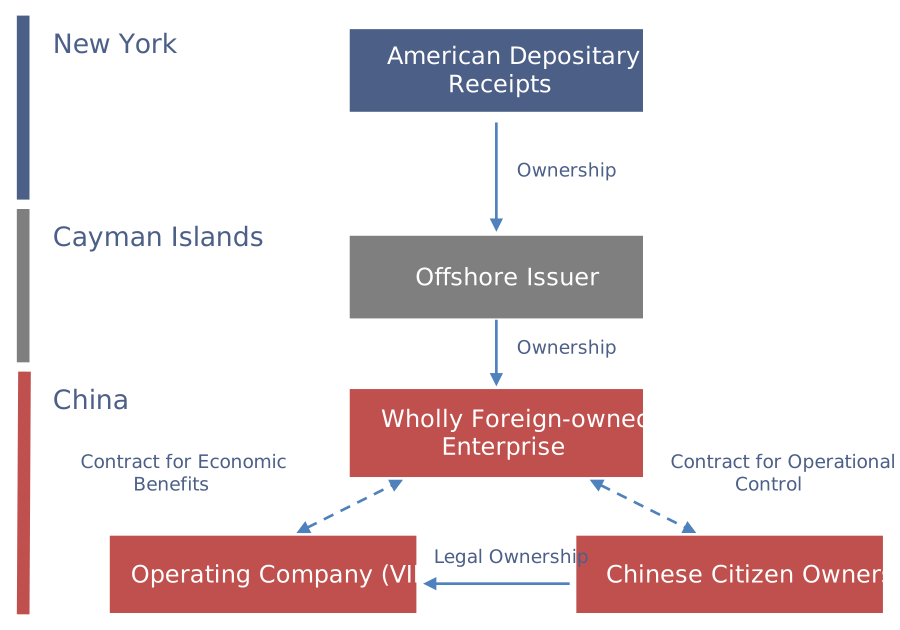
It is worth reviewing what a VIE is and why it came into being. As shown in Figure 1, the VIE is a structure by which an offshore entity, usually domiciled in the Cayman Islands, owns a wholly foreign-owned enterprise (WFOE) in China. This WFOE then has a series of contractual relationships with a Chinese business that allow it to exert operational control and receive economic benefit from that Chinese enterprise. The purpose behind creating this convoluted structure was to bypass foreign ownership restrictions that China maintains in many industries. The most notable of these is value-added telecommunications, which encompasses a wide variety of technology-related businesses.2
- Source: Seafarer.
The VIE structure solved several problems for Chinese tech companies. First, many of them would not have been permitted to list in China’s domestic equity markets because restrictions at the time prevented unprofitable companies from listing. Second, it allowed them to sell shares to international investors, giving them access to a larger potential pool of capital and, in some cases, higher valuations. Third, the offshore listing structure permitted dual-class share arrangements that let founders maintain control through weighted voting rights, a practice that for many years was not allowed by the mainland or Hong Kong exchanges.
However, the VIE structure also introduced new and potentially significant risks. First, using contracts to exert control over and derive economic benefit from another company relied on the Chinese counterparty, often the founder of the company, honoring those contracts. In some instances, these contracts were disrupted by divorce, business disputes, and other events, threatening the control of foreign investors and leading to losses. Second, for years Chinese regulators refrained from endorsing the VIE structure, leaving open the risk that regulatory changes could dismantle foreign investors’ economic interests in the companies.
A Wave of Regulatory Challenges and Reforms
Since I wrote The China Investment Dilemma in 2020, a series of regulatory shocks have challenged the VIE structure. The first came from the U.S. government through the Holding Foreign Companies Accountable Act, which threatened to force Chinese companies to delist from American exchanges. Driving the legislation was a dispute between the Chinese and American governments over access to information on Chinese companies. The Public Company Accounting Oversight Board (PCAOB), the audit regulator for the United States, demanded access to the underlying audit documentation for Chinese companies listed on American exchanges. Chinese regulators refused to grant blanket access, arguing that corporate information sent to the PCAOB must be intermediated through Beijing. For VIE companies, this dispute compounded the separate legal uncertainty created by the lack of direct ownership of the Chinese operating business.
While American and Chinese regulators ultimately came to an agreement that would allow Chinese companies to stay listed by granting U.S. regulators inspection access to the workpapers of their China-based auditors, the threat of delisting had already led many Chinese companies to leave the U.S. voluntarily or set up a secondary listing in Hong Kong as a hedge.3
The second regulatory shock came from the Chinese government, which precipitated a chaotic delisting of Didi Chuxing, China’s equivalent to Uber, from the New York Stock Exchange. Didi, using a VIE structure, listed to much fanfare in June 2021. However, less than a year later it was effectively forced to delist when Chinese regulators accused the company of ignoring their directives.4 The sudden delisting of a company of that profile put a spotlight on the uncertainties around Chinese overseas listings and VIE structures in particular.
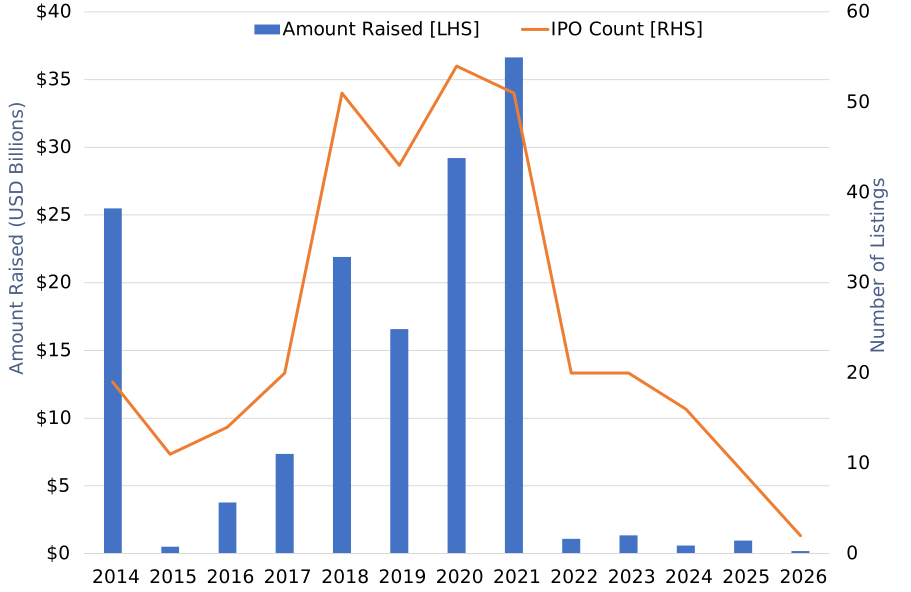
As shown in Figure 2, these two shocks helped drive a dramatic decline in the number of Chinese VIEs listing overseas and the amount of funds raised. A fundraising channel that had previously raised tens of billions of dollars per year collapsed to a trickle from 2022 onward.
- Sources: Bloomberg; Wind Information; Council of Institutional Investors; Seafarer.
Hong Kong and Mainland Regulatory Changes
The collapse of the VIE structure did not cut off Chinese tech companies from capital markets. Instead of New York, both the Hong Kong and mainland exchanges became their default listing destinations.
A series of important reforms paved the way for this change. In Hong Kong, the exchange began allowing dual-class shares in 2018 and opened an easier secondary-listing route for Chinese companies already listed in New York.5 Alibaba, JD.com, and Baidu all took that path. Rule changes in 2022 loosened that route further, letting these companies list in Hong Kong as a primary venue while keeping their dual-class shares and VIE structures.6 On the mainland, the STAR Market of the Shanghai Stock Exchange launched in 2019 with new listing rules that permitted unprofitable early-stage companies to list, opening a domestic path for more Chinese tech companies.7 ChiNext, the Shenzhen exchange’s growth board, followed in 2020 and 2023 with reforms to accommodate weighted voting rights, unprofitable early-stage companies, and offshore issuers.8
In 2023, the China Securities Regulatory Commission (CSRC) issued a new filing regime for all overseas listings of Chinese firms.9 By recognizing the existence of VIEs as a valid offshore listing structure, the CSRC removed much of the regulatory ambiguity surrounding VIEs. However, the changes also meant much tighter scrutiny for Chinese companies seeking to list abroad, which now cannot proceed without de facto approval from the Chinese government. These new rules also led several Chinese companies to preemptively unwind their VIE structures to improve the odds that their listing applications will be approved by the CSRC.10
Closer to Home and Under Tighter Control
While many established Chinese tech companies are still VIEs, the VIE structure has lost its dominance among new listings. One way to see the changes to how Chinese companies list is to examine the recent wave of listings in artificial intelligence and related industries. Strikingly, these companies have raised significant amounts of capital almost exclusively outside the VIE structure. As shown in Figure 3, nearly every AI-linked Chinese company listed either through an offshore parent with direct ownership or as a mainland company issuing shares offshore. Of the more than $47 billion raised, virtually all of it was raised in Hong Kong and the mainland, rather than from U.S. capital markets.11
- Sources: Company Filings; Wind Information; Bloomberg; Seafarer.
- Note: Listing proceeds include greenshoe (overallotment) option where exercised. Number of listings includes four companies that underwent dual listings.
It is clear that the tumultuous regulatory changes imposed by both the U.S. and Chinese governments have produced a sea change in how Chinese tech companies structure their listings. As the AI-related listings above show, domestic markets can now credibly substitute for overseas listings. A decade ago, steering companies away from New York would have come at a far steeper cost to their ability to raise capital.
Pressure from Beijing has continued to push in this direction. Amid heightened U.S.-China strategic competition, the Chinese government is increasingly focused on maintaining control over technology companies it believes hold cutting-edge capabilities, especially where those capabilities carry national security implications. It is no accident that Beijing’s policies have led to Chinese companies abandoning the VIE structure and listing on mainland or Hong Kong exchanges. Keeping these companies closer to home and under its own regulatory supervision allows the Chinese government to better monitor and control them.
End of an Era
The VIE was a unique listing structure that raised more than $150 billion for Chinese tech companies.12It also gave foreign investors significant economic exposure to Chinese companies that would normally have been off-limits because of foreign ownership restrictions. For roughly two decades, the VIE helped make overseas markets, particularly New York, an important listing venue for many of China’s largest internet companies.
That era is now over. The fragile foundation that undergirded the VIE structure was toppled by U.S.-China mistrust and Beijing’s drive for greater control. Foreign investors can still invest in the new generation of Chinese technology firms, but they do so in capital markets firmly under Beijing’s control.
What is remarkable, and perhaps underappreciated, is that China’s capital markets have matured, in both regulation and depth, into a viable alternative to listing overseas. In 2025, a wave of mainland company listings made Hong Kong the world’s top IPO fundraising venue.13 On the mainland, tech-focused boards like Shanghai’s STAR Market can now absorb multibillion-dollar offerings, such as memory maker CXMT’s $9.8 billion IPO in July 2026.14 U.S. capital markets, which were once so dominant as a source of funding for Chinese tech companies, now play a distinctly secondary role to Hong Kong and the mainland.
Nicholas Borst,- The views and information discussed in this commentary are as of the date of publication, are subject to change, and may not reflect Seafarer’s current views. The views expressed represent an assessment of market conditions at a specific point in time, are opinions only and should not be relied upon as investment advice regarding a particular investment or markets in general. Such information does not constitute a recommendation to buy or sell specific securities or investment vehicles. It should not be assumed that any investment will be profitable or will equal the performance of the portfolios or any securities or any sectors mentioned herein. The subject matter contained herein has been derived from several sources believed to be reliable and accurate at the time of compilation. Seafarer does not accept any liability for losses either direct or consequential caused by the use of this information.
- As of September 30, 2026, the Seafarer Funds did not own shares in the securities referenced in this commentary.
- Tamrat, Emmanuel. “Behind the Veil: Risks of Chinese Companies and the VIE Structure: An Update.” Council of Institutional Investors, August 2025.
- “Sina Corporation, Annual Report (Form 20-F), Fiscal Year Ended December 31, 2019.” filed April 29, 2020, U.S. Securities and Exchange Commission.
- “Fact Sheet: PCAOB Secures Complete Access to Inspect, Investigate Chinese Firms for First Time in History.” Public Company Accounting Oversight Board, December 15, 2022.
- “Reaction to Didi Global’s Plans to Delist from New York.” Reuters, December 3, 2021.
- “Hong Kong’s Listing Regime Enters New Era, Featuring Emerging and Innovative Firms.” Hong Kong Exchanges and Clearing Limited, April 24, 2018.
- “Update No. 134: Amendments to the Main Board Listing Rules Relating to the Listing Regime for Overseas Issuers.” Hong Kong Exchanges and Clearing Limited, November 2021, effective January 1, 2022.
- “Listing Overview.” Shanghai Stock Exchange, accessed September 15, 2026.
- “SZSE’s Press Conference on the Publication of the Business Rules for Reform of the ChiNext Board and Piloting the Registration-based System.” Shenzhen Stock Exchange, April 30, 2020; and “SZSE Makes Arrangements for the Implementation of Listing Standards for Unprofitable Enterprises on ChiNext.” Shenzhen Stock Exchange, February 21, 2023.
- “CSRC Releases New Regulations for Filing-based Administration of Overseas Offering and Listing.” China Securities Regulatory Commission, February 17, 2023.
- Yue Yue. “Caixin Explains: Why China Is Cooling on VIE Structures.” Caixin Global, April 21, 2026.
- Only 4 of the 58 listings were on U.S. exchanges, representing around 2% of funds raised. ZEEKR has since delisted, and Hesai, WeRide and Pony AI all listed on Nasdaq before adding secondary listings in Hong Kong.
- Based on Seafarer’s calculation using data from Bloomberg, Wind Information, and the Council of Institutional Investors.
- “Hong Kong ECM 2025 Recap: Liquidity, Listings and Record-Scale Equity Issuance.” Hong Kong Exchanges and Clearing Limited, February 9, 2026.
- IPO proceeds include greenshoe overallotment.


