
- Stronger consumption is essential to sustaining economic growth in China.
- Chinese household consumption and consumer confidence remain well below pre-Covid levels.
- Removing strict regulations on the service sector could open space for the private sector to grow and ignite the growth of consumption.
Prevailing Winds is a China-focused blog written by Nicholas Borst, Vice President and Director of China Research at Seafarer. The blog tracks the economic and financial developments shaping the world’s largest emerging market.
The Chinese economy is dependent on three pillars: consumption, investment, and net exports.1 At the current moment, both consumption and investment are weak and growing much more slowly than in recent years. This means that the Chinese economy has relied heavily on exports over the past two years to maintain growth, as shown in Figure 1. Such dependence on exports seems unsustainable as China’s trade surplus reaches record levels and other countries put up new trade barriers in response.
China’s investment woes are well understood. Private sector investment has slowed dramatically amid the collapse of the property market and the bankruptcy of China’s private real estate developers. Government investment has also weakened due to growing financial pressure on local governments from rising debt levels. Strains on private and public balance sheets have caused China’s investment-led growth engine to sputter. These challenges are likely to constrain investment growth for years to come.
The slowdown in consumption is a more complicated problem. Chinese household consumption slowed sharply during the large-scale Covid lockdowns between 2020 and 2022 and has not returned to pre-Covid growth trends. Chinese consumers did not experience a reopening boom in the way those in the U.S. and other countries did. This makes it all the more important to understand what is holding back Chinese consumption and how it can be revitalized into a stronger driver of economic growth.
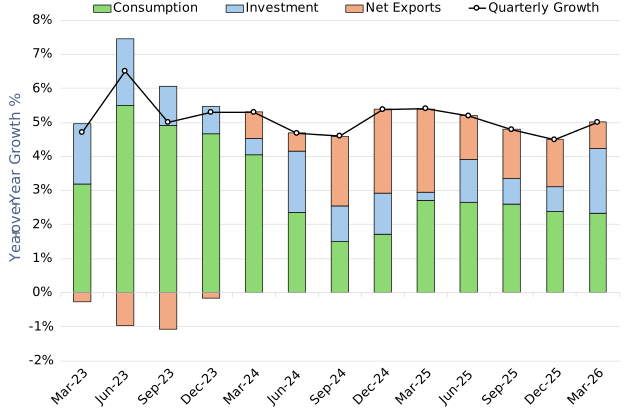
- Source: National Bureau of Statistics of China.
Tracking Consumption
The economic indicators for consumption in China show a pronounced slowdown relative to historical growth rates. As shown in Figure 2, the contribution of consumption to GDP growth slowed precipitously during China’s Covid lockdowns. Since reopening the country in 2023, consumption has recovered somewhat but remains well below its pre-Covid pace.
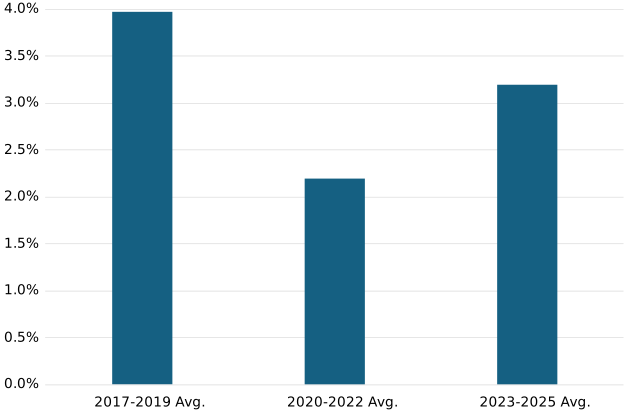
- Source: National Bureau of Statistics of China.
Household consumption, which accounts for around 70 percent of all consumption in China, tells the same story.2 As shown in Figure 3, both per capita urban consumption and retail sales of consumer goods remain materially below pre-Covid growth rates.
Three-Year Compound Annual Growth Rate (CAGR)
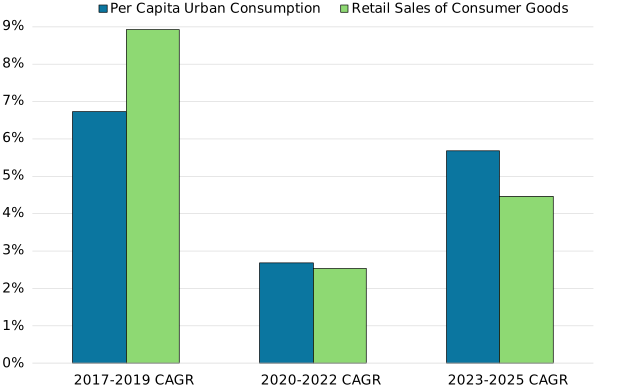
- Source: National Bureau of Statistics of China.
Several factors help explain the weak recovery in consumption. China’s stimulus efforts during the pandemic were much less focused on promoting consumer spending than those in the United States and other countries. At the same time, the collapse of the housing market, rising unemployment, and regulatory crackdowns on the private sector have made households increasingly cautious about spending. As shown in Figure 4, even the official statistics show a marked decline in consumer confidence.
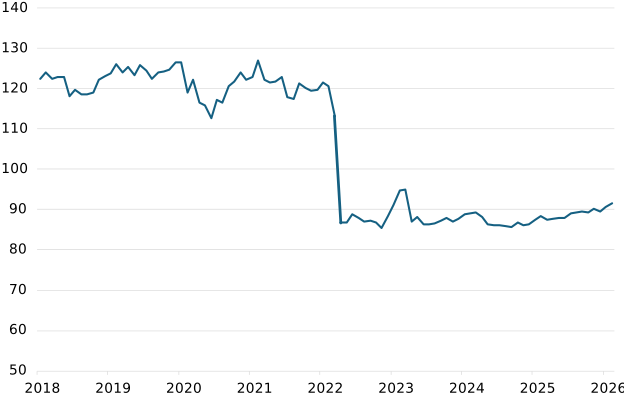
- Source: National Bureau of Statistics of China.
Is Chinese Consumption being Measured Correctly?
Before delving deeper into this topic, it is important to address the debate over whether consumption is being measured correctly in the first place. The statistical figure that has been the biggest source of debate is China’s consumption share of GDP, as seen in Figure 5. At around 40% of GDP, household consumption in China is lower than in other major economies. A similar statistic in the U.S., personal consumption expenditures, is around 68% of GDP. The relative share of household consumption is so low that it has prompted economists to critically evaluate whether the statistic is properly measured.
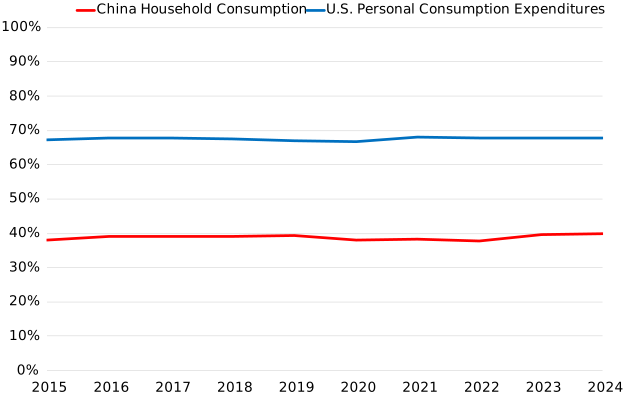
- Sources: National Bureau of Statistics of China; Federal Reserve Bank of St. Louis.
There are several key arguments that have been put forward to highlight the potential measurement error associated with this statistic.
Social Transfers: One way that Chinese consumption may be underestimated is that spending via social transfers is not included. Social transfers are goods and services provided by the government to households rather than procured in the market. As Nicholas Lardy and other economists have pointed out, including social transfers raises the household consumption share of GDP by 7 percentage points in 2023.3
Flawed Surveys: Another problem that is frequently highlighted is the methodological issues with household surveys conducted by the government, which are used to compile many consumption statistics. These surveys are known to underreport household income and consumption, particularly for wealthy households, and may also miss activity in the gray economy, such as domestic help, off-the-books services, freelance work, and other unreported activities.
Housing Services Calculation: Housing services in China, which measure both rent paid to landlords and the imputed rent of owner-occupied housing, may contribute to an underestimation of consumption due to the government’s statistical methodology choices. According to economist Tao Wang, China calculates imputed rents based on original construction costs rather than the more standard practice of using market-based rents.4 Adopting this more standard methodology would raise the household consumption share of GDP by 5 percentage points.
Cheap Goods and Services: Some economists argue that, on a per capita basis, Chinese household consumption is not low by global standards.5 The volume of goods and services Chinese households consume is broadly in line with, or even higher than, that of countries at similar income levels. However, this does not explain why consumption’s share of GDP remains unusually low. In other words, if goods and services are so cheap, why aren’t Chinese households consuming even more of them relative to countries where they are more expensive?
These arguments suggest that Chinese consumption, especially as a share of GDP, may be understated in official statistics. Even taking these critiques into account, however, the key point remains that consumption growth in China has slowed considerably compared to recent years. The challenge posed by slowing consumption for China’s economy therefore remains.
Government Plans to Boost Consumption
The urgency of the situation has prompted the Chinese government to draft a series of high-level policies focused on reviving consumption. The most significant has been the central government’s “Special Action Plan for Boosting Consumption.”6 Released in March 2025, the Special Action Plan contains a long list of reforms and initiatives to address both cyclical and structural barriers to consumption. Building on this plan, a group of six Chinese government ministries released a follow-up action plan in late November 2025 outlining a series of specific measures to promote consumption.7 At a high level, the priority areas for these two government consumption plans are:
Growing Household Income: The Chinese government wants to boost households’ ability to consume through broadening employment, supporting wage growth, and expanding income earned from financial assets and properties.
Trade-In Programs: The government has created several short-term trade-in programs that provide subsidies for consumers to purchase new automobiles, home appliances, home furnishings, and consumer electronics.
Social Spending: China is increasing social spending to lower precautionary saving. The idea behind these programs is that if Chinese households have more support paying for healthcare, education, insurance, and retirement expenses, they will feel freer to spend more on consumption and save less of their income.
Boosting Supply: The Chinese government is focused on increasing the “supply” of consumer goods and services as a way to boost overall consumption. Chinese policymakers believe supply challenges, such as too few tourism sites or not enough elder care facilities, mean that consumers are spending less than they would like to.
Improving the Business Environment: Policymakers believe that consumption has been hurt by the many challenges facing the private sector. Private firms face significant delays in getting paid by local governments and state-owned enterprises (SOEs). They also encounter a variety of barriers when competing for contracts with state-owned firms. There is also mention of pilot programs in the telecommunications, healthcare, and education sectors to increase opportunities for private firms, a major challenge discussed in the next section.
The Service Consumption Deficit
A critical but underappreciated factor in reviving consumption in China is the urgent need for service sector reform. Less than half of China’s consumption spending goes toward services.8 This share has remained stagnant since 2019, bucking the trend toward more service-heavy consumption as countries grow richer.9 China remains far below the 60 to 70 percent level common in more developed countries.10
One reason that services have grown slowly in China is that government policy has hindered the development of China’s service sector. China has strict regulations that prevent more competition in service industries and entrench the role of state-owned firms. The service sector retains significant barriers to both foreign and private investment. As shown in Figure 6, according to the OECD’s global comparison of service sector restrictiveness, China is substantially more restrictive than the OECD and global averages.
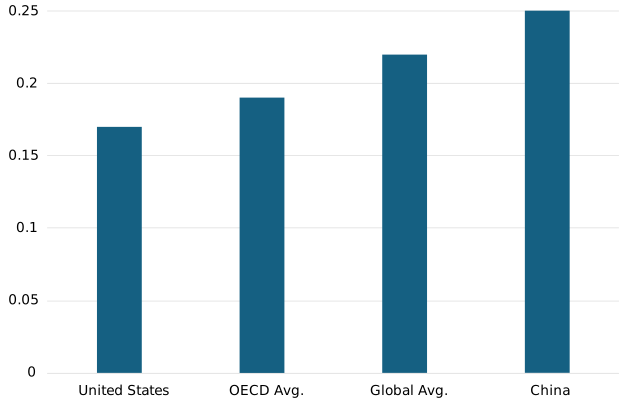
- Source: OECD.
A recent example illustrates these issues. Nintendo recently closed its digital game store in China. Despite record-breaking global sales, Nintendo struggled to maintain a foothold in the Chinese market due to a set of service sector restrictions that have hindered its operations. First, China bars foreign-invested firms from directly engaging in online publishing, which is why Nintendo entered the market through a partnership with Tencent.11 Second, China requires the servers and storage used for online publishing services to be located domestically and regulates cross-border data transfers.12 This limited Nintendo’s ability to integrate the Chinese digital store into its global business. Third, China has a strict censorship and approval process for new games, which limited Nintendo to selling only a small fraction of the titles available on its global platforms.13 These types of intrusive restrictions are prevalent across the service sector and have done much to stunt the growth of service industries in China.
The other barrier to the service sector is the high concentration of SOEs in many service industries.14 Most educational institutions in China are government owned. Private educational companies had carved out a niche in after-school tutoring, but this market was decimated by regulatory prohibitions in 2021.15 The banking, insurance, and brokerage industries are dominated by state-owned firms.16 A similar situation exists with passenger air and rail transportation, which are controlled by large state-owned conglomerates.17 State-owned hospitals account for nearly three-quarters of bed capacity in China and fully-foreign owned hospitals are only allowed in a few regions.18 Private and foreign enterprises are largely prohibited from operating in broadcast media and publishing. The utility and telecommunications sectors are both dominated by large state-owned firms.19 Given that large swathes of the service sector are controlled by state firms or government institutions, it is little surprise that services have grown more slowly than other areas of the Chinese economy.
Behind the stunted development of China’s service sector are restrictive regulations and entrenched state-owned firms. This has contributed to slower growth in overall consumption. Private firms are constrained by these barriers and face difficulty entering many service industries. While China has a long list of plans to boost consumption, it is hard to envision those plans succeeding without a vibrant, rapidly expanding service sector. Achieving this goal will require the government to take service sector reform seriously and to reduce the role of state firms.
Nicholas Borst,- The views and information discussed in this commentary are as of the date of publication, are subject to change, and may not reflect Seafarer’s current views. The views expressed represent an assessment of market conditions at a specific point in time, are opinions only and should not be relied upon as investment advice regarding a particular investment or markets in general. Such information does not constitute a recommendation to buy or sell specific securities or investment vehicles. It should not be assumed that any investment will be profitable or will equal the performance of the portfolios or any securities or any sectors mentioned herein. The subject matter contained herein has been derived from several sources believed to be reliable and accurate at the time of compilation. Seafarer does not accept any liability for losses either direct or consequential caused by the use of this information.
- As of March 31, 2026, the Seafarer Funds did not own shares in the securities referenced in this commentary.
- In Chinese Gross Domestic Product (GDP) accounting, government spending is included in both the investment and consumption components of GDP rather than accounted for as a separate category.
- Based on data from the National Bureau of Statistics of China and Seafarer’s calculations. The other portion of consumption is accounted for by government consumption.
- Lardy, Nicholas R. "Does a Weak Social Safety Net Hold Back Private Consumption in China?." Policy Brief 25-7. Peterson Institute for International Economics, December 2025.
- Wang, Tao. Making Sense of China's Economy (London: Routledge, 2023).
- Yu Fei and Guo Kai. "China's Consumption Is Not Nearly as Low as It Appears." CF40 Research, August 26, 2025.
- General Office of the CPC Central Committee and General Office of the State Council. "Special Action Plan for Boosting Consumption (提振消费专项行动方案).” State Council Gazette, no. 9, 2025.
- "Notice on the Issuance of the Implementation Plan for Enhancing the Supply-Demand Compatibility of Consumer Goods to Further Promote Consumption (关于增强消费品供需适配性进一步促进消费的实施方案).” Ministry of Industry and Information Technology, Document No. 252, November 25, 2025.
- "National Economy Pushed Forward with Innovation-led and High-quality Development and Expected Targets Achieved Successfully in 2025." National Bureau of Statistics of China, Press release, January 19, 2026.
- "Statistical Communiqué of the People's Republic of China on the 2019 National Economic and Social Development (中华人民共和国2019年国民经济和社会发展统计公报).” National Bureau of Statistics of China, February 28, 2020.
- Guo Chunli and Jiang Xue. "Service Consumption and 'Investing in People' Key Drivers of Domestic Demand Expansion." CGTN, March 27, 2025.
- Kipfer, Arlo. "China Online Gaming Laws." Harris Sliwoski LLP, December 29, 2021.
- "China Imposes New Restrictions on Internet Content." Dorsey & Whitney LLP, March 25, 2016.
- Doolan, Liam. "Random: There's Now a Grand Total of Three Games on the Switch eShop in China." Nintendo Life, March 18, 2020.
- Novta, Natalija, Robert Zymek, and Yizhi Xu. "Service Sector Productivity, Allocative Efficiency and Innovation, in People's Republic of China: Selected Issues, IMF Country Report No. 24/276.” International Monetary Fund, Washington, DC, August 2024, pages 13–26.
- "Wide-Ranging Guideline to Rein in Tutoring Sector." China Daily, July 26, 2021.
- Firms with a state-owned controlling shareholder accounted for 87% of total revenues of the capital markets industry in the Bloomberg China Large, Mid, and Small Cap USD Index in 2024. Firms with a state-owned controlling shareholder accounted for 84% of total revenues of the commercial banks industry in the Bloomberg China Large, Mid, and Small Cap USD Index in 2024. Firms with a state-owned controlling shareholder accounted for 55% of total revenues of the insurance industry for the Bloomberg China Large, Mid, and Small Cap USD Index in 2024. If Ping An Group is included, a company which is classified as mixed ownership but has important state shareholders, the total rises to 86%. Based on Seafarer’s calculations using the methodology from Borst, Nicholas. "What's Wrong with Chinese Corporate Profits?." Seafarer Capital Partners, April 2025.
- Firms with a state-owned controlling shareholder accounted for 81% of total revenues of the passenger airlines industry in the Bloomberg China Large, Mid, and Small Cap USD Index in 2024. China’s main national rail operator, China State Railway Group, is an unlisted state-owned enterprise. There are a few listed railway companies in China. Firms with a state-owned controlling shareholder accounted for 99% of total revenues of the railway transportation sub-industry in the Bloomberg China Large, Mid, and Small Cap USD Index in 2024. Based on Seafarer’s calculations using the methodology from Borst, Nicholas. "What's Wrong with Chinese Corporate Profits?." Seafarer Capital Partners, April 2025.
- Huang, Yanzhong. "China's Hospital Admission Paradox: Institutional Design and Perverse Incentives." Council on Foreign Relations, October 25, 2024.
- Firms with a state-owned controlling shareholder accounted for 87% of total revenues of the communications services sector in the Bloomberg China Large, Mid, and Small Cap USD Index in 2024. Firms with a state-owned controlling shareholder accounted for 84% of total revenues of the utilities sector in the Bloomberg China Large, Mid, and Small Cap USD Index in 2024. Based on Seafarer’s calculations using the methodology from Borst, Nicholas. "What's Wrong with Chinese Corporate Profits?." Seafarer Capital Partners, April 2025.
![[Chrome]](/_layout/images/ua/chrome.png)
![[Firefox]](/_layout/images/ua/firefox.png)
![[Opera]](/_layout/images/ua/opera.png)
![[Microsoft Edge]](/_layout/images/ua/edge.png)