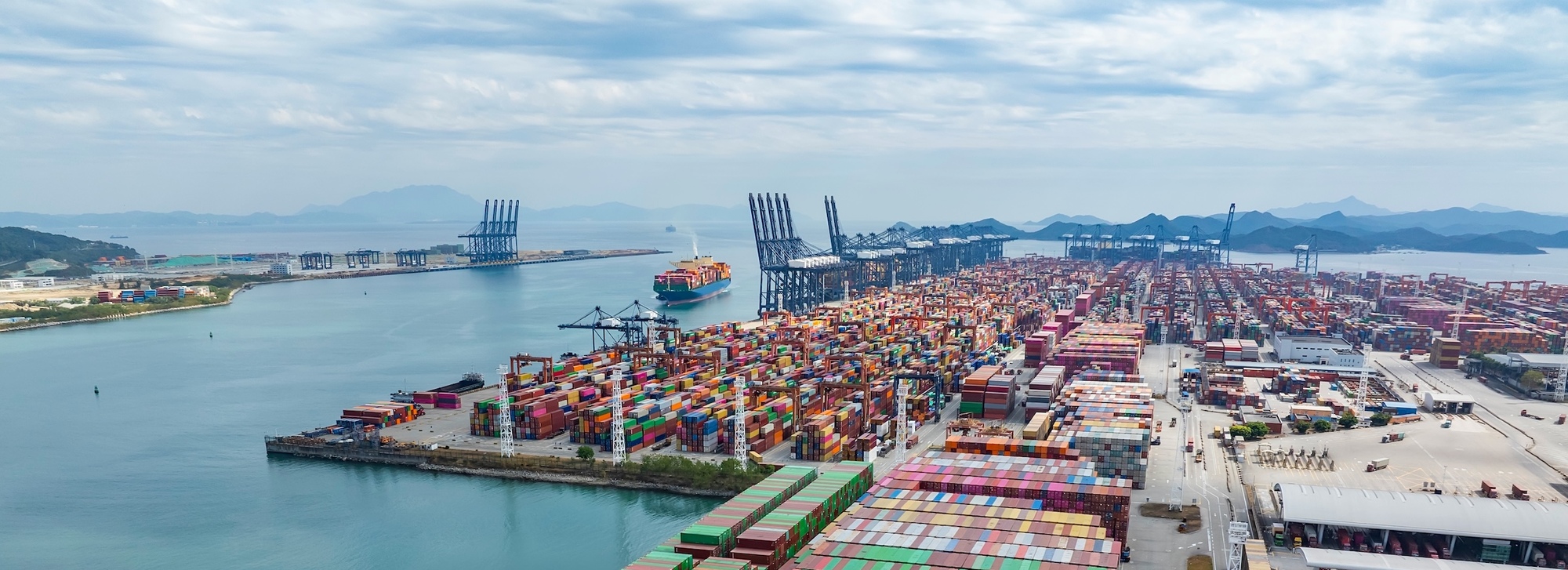
- Chinese companies are disrupting a number of global industries, including clean tech, heavy industry, strategic materials, and manufacturing.
- Beijing’s influence over capital and resource allocation means that it can pursue industrial policy on a scale that few countries can match.
- The combination of intense domestic competition, scale, and industrial policy in China creates globally competitive firms, but it also produces overcapacity that surges outward as exports.
Prevailing Winds is a China-focused blog written by Nicholas Borst, Vice President and Director of China Research at Seafarer. The blog tracks the economic and financial developments shaping the world’s largest emerging market.
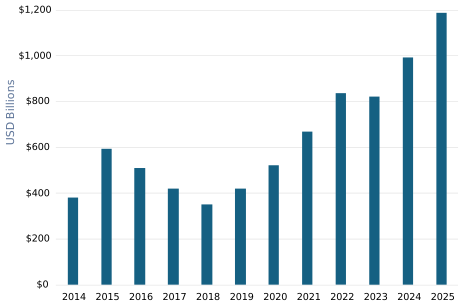
Concerns over China’s impact on global markets have reached new heights as the country’s trade surplus has grown to staggering levels. As shown in Figure 1, China’s trade balance reached nearly $1.2 trillion in 2025.1 The sheer size of this surplus has strained China’s economic relations with the rest of the world, which has been on the receiving end of a flood of Chinese goods. This has led to renewed calls for tariffs and restrictions on Chinese exports from many of its largest trading partners.
- Source: China General Administration of Customs.
China’s disruptive impact on global industries is larger than what trade surplus numbers alone suggest. Over the past decade, the sudden emergence of competition from China has transformed industries worldwide through falling prices, compressed margins, and the loss of market share for incumbent firms. While Chinese firms often undercut competitors on price, it would be a mischaracterization to label them as merely low-price producers. Honed by intense domestic competition, Chinese companies have developed significant technical and manufacturing expertise. Chinese firms are quickly moving up the value chain, transforming from low-end assemblers into important players in many major global industries.
This combination of price competitiveness and technical capability has laid the groundwork for China’s expansion across a wide range of sectors. Yet market forces and the raw competitiveness of Chinese firms is not sufficient to explain the scale of the economic disruption. The rise of Chinese companies is also deeply intertwined with the country’s large-scale industrial policies.
Mapping China’s Global Economic Disruption
To understand the scope of China’s economic disruption, it is helpful to visualize it. One way to do so is mapping the industries in which Chinese firms are increasing their share of global exports. The impact of Chinese firms is clearly visible across four categories of industry: clean tech, heavy industry, strategic materials, and manufacturing.
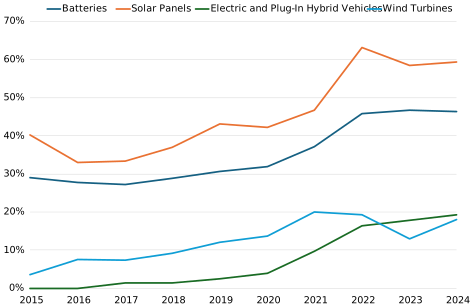
Clean Tech: China’s clean tech firms have rapidly emerged as global leaders in this burgeoning industry. Not only is China installing huge clean energy capacity at home, but its firms are now exporting these technologies abroad. As shown in Figure 2, Chinese firms account for a commanding share of global exports in batteries, solar panels, electric and plug-in hybrid vehicles, and wind turbines.
- Sources: Seafarer; International Trade Centre.2
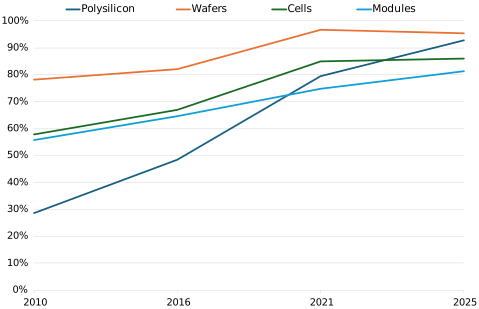
The Chinese share of global solar exports is even higher than the chart above would suggest. To avoid tariffs, Chinese companies have shifted panel assembly to countries in Southeast Asia, thereby reducing China’s nominal share of solar exports. China’s control over the solar supply chain is nearly unchallenged. As shown in Figure 3, Chinese solar panel manufacturers have built a near monopoly over the production of polysilicon, wafers, cells, and modules.
- Sources: Seafarer; International Energy Agency.3
- Note: 2025 values based on projects under construction, proposed, and planned.
Heavy Industry: China’s huge industrial base at home is translating into a growing share of global heavy industry exports. China now holds leading positions in the shipbuilding, port machinery, and construction equipment markets, as shown in Figure 4. The country’s growing dominance in these industries also has important geopolitical implications, as they are key components of the national defense industrial base.
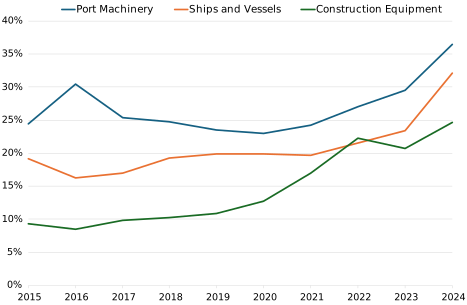
- Sources: Seafarer; International Trade Centre.4
Figure 5 shows the rapid increase in Chinese shipbuilding capacity relative to the two incumbent global leaders, Japan and South Korea.
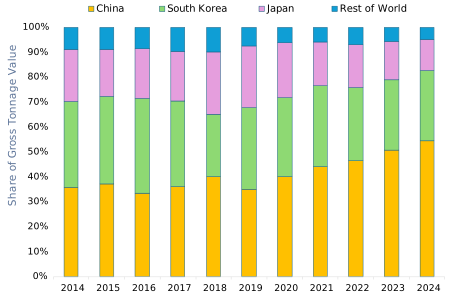
- Sources: Seafarer; United Nations Conference on Trade and Development (UNCTAD).5
Strategic Materials: China has achieved growing dominance in a number of strategic materials. As shown in Figure 6, China has significant influence over global trade in antibiotics, industrial magnets, and steel and iron. These materials are critical inputs to many global industries, and like heavy industry, they have important national security implications. Some of China’s influence over strategic materials, such as in industrial magnets, is related to control over upstream materials such as rare earths.
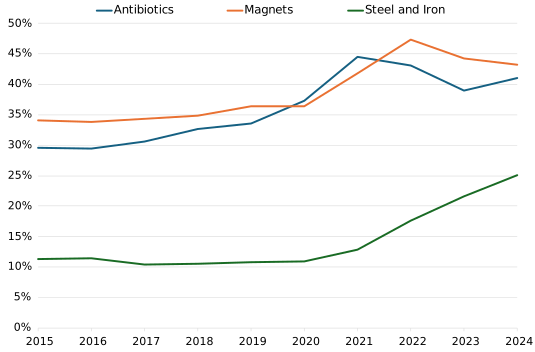
- Sources: Seafarer; International Trade Centre.6
Even in non-strategic but still important backbone industries, such as chemicals, China has disrupted the incumbent western firms. As shown in Figure 7, China has emerged as one of the largest sources of global chemical exports, second only to the European Union. Active pharmaceutical ingredients are another key input category in which China has captured significant market share.7
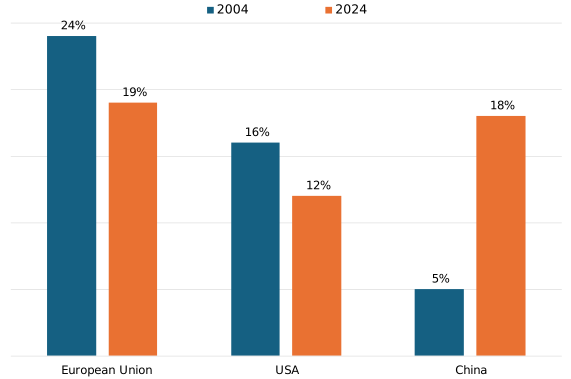
- Source: European Chemical Industry Council.8
Manufacturing: Chinese firms are making substantial inroads into higher value-added manufacturing, an area that has previously been dominated by multinational corporations from developed countries. As shown in Figure 8, Chinese firms have a growing share of global exports in industrial robots, air conditioners and heat pumps, high-end medical equipment, and advanced machine tools. Many of these industries were targeted by industrial policies such as Made in China 2025. Chinese companies entered these industries as low-end players and then improved the quality of their products to the point where they could compete with multinationals at the high end.
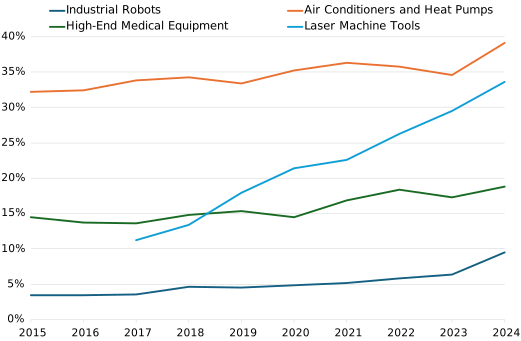
- Sources: Seafarer; International Trade Centre.9
The Engines Behind China’s Global Disruption
Why does China create such large and disruptive impacts on so many industries? There are several factors to keep in mind. First, as China develops economically, it has begun to move up the value chain into new industries. Many East Asian countries have followed the “flying geese model,” starting with labor intensive industries and gradually moving into higher value added and more complex sectors.10 These nations started by importing goods from more advanced economies, then started producing them internally, and then finally began exporting them abroad. China’s push into more advanced industries follows the path of Japan and South Korea, as those economies grew rapidly and became more technologically sophisticated.11
Second, the size of China’s population and its massive industrial base allow it to compete across a wider range of industries than smaller economies. The country’s large and varied manufacturing capacity places China in a small group of countries – principally the United States, Germany, and Japan – that can compete across a wide variety of export goods. In fact, China has the most diverse range of goods exports of any major exporter.12 By contrast, the exports of smaller economies such as South Korea, Singapore, Taiwan, and Malaysia are significantly more concentrated, as only a few domestic industries grow to a scale that allows them to compete globally.
There is, however, a third and critically important factor driving China’s global economic disruption: its use of state-directed industrial policy on a massive scale. The use of industrial policy to develop strong export industries is not unique to China. Japan, South Korea, Taiwan, and Singapore have all pursued industrial policy to promote strategic sectors, especially those with strong export potential. For example, Taiwan’s current dominance in high-end semiconductor manufacturing is closely tied to government efforts to foster that industry.13
What differentiates industrial policy in China is that Beijing exerts influence over capital and resource allocation that few countries can match. Figure 9 shows a recent IMF estimate of Chinese industrial policy spending, including direct subsidies, tax preferences, and below-market land and credit. Averaging around 4.5% of GDP for over a decade, Chinese industrial policy has operated at a massive scale for an extended period.
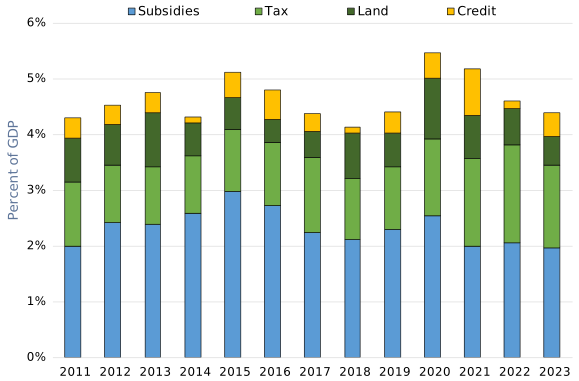
- Source: International Monetary Fund.14
In theory, Beijing should be quite pleased with the results of its massive spending on industrial policy. Over the past decade, China has made substantial progress in reducing its dependency on foreign imports in many industries.15 Even more impressively, as shown above, Chinese firms have made sizeable inroads into overseas markets in many of the most important global industries. China is now a major player in many globally important industries and exercises extensive influence over several strategic resources. Xi Jinping’s focus on promoting economic self-reliance and on advancing industries such as batteries, electric vehicles, and high-tech manufacturing seems to be succeeding.
Walking a Tightrope
The success of China’s approach to industrial policy relies upon a delicate balance. Economic planners in Beijing seek to precisely allocate resources and calibrate policy to foster domestic industries and create competitive firms. They are often successful in laying the groundwork for competition. A flood of resources leads to new firms being established and a battle for market share and profits. In this environment, truly competitive firms can be created. The problem for Beijing is that China’s economic structure often leads to industrial policies spiraling out of control.
The central government sets forth high-level industrial policies, but it relies upon many different actors to actually implement them. Local governments end up writing many of the checks to finance Beijing’s economic plans. Local officials compete to advance both their localities and their careers by enthusiastically supporting central government policies. This often leads to overinvestment and inefficient duplication of industries.
State banks and investment funds have similar incentives to over-deliver on financial support for government policies. The loans and investments made by these institutions are often distorted by political priorities rather than sound financial decision-making. Similarly, state-owned enterprises rush to announce investments in support of government policy, regardless of the underlying economic rationale.
These dynamics are further distorted by pressure from the Chinese government on banks to avoid economic disruption. Even when an industry has fallen into overcapacity and is rife with loss-making firms, banks are reluctant to withdraw funding because regulators seek to prevent messy bankruptcies that could affect employment and economic growth. This results in excess supply and loss-making firms lingering in industries far longer than they should.
As I argue in Nobody Wins in a Price War: Destructive Competition in China, the end result of the country’s industrial policy is that it both creates ferociously competitive firms and leads to overcapacity and depressed profitability within an industry. Over the past year, Xi Jinping and other officials have frequently called for an end to “disorderly low-price competition among corporations.”16 A growing number of industries have fallen into overcapacity, with productive capacity far outstripping domestic demand and margins compressed so thinly that large numbers of firms have become unprofitable.
One way to observe this phenomenon is through the consistently lower rate of return across a wide swath of industries in China compared with global averages. Aswath Damodaran of New York University reports return on equity (ROE) for publicly traded firms across different industries and geographies. Using that dataset, Figure 10 shows that the aggregate return on equity of Chinese firms is substantially below that of firms in emerging markets, the world, and the United States. In Damodaran’s industry groupings, Chinese firms have a lower return on equity than the global average in more than three-quarters of industries.
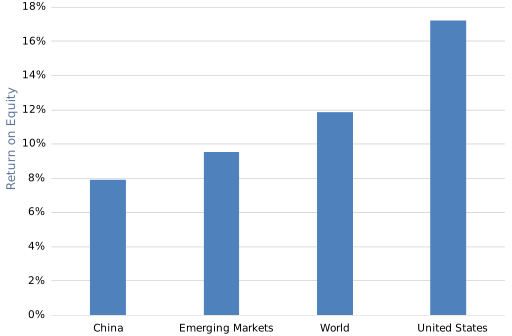
- Sources: Seafarer; New York University.17
Cleaning Up the Mess
Beijing is generally less concerned with short-term industry profitability for its own sake. The government’s reliance on revenue-based taxes, such as the value-added tax, means that corporate profits are a less significant source of tax revenue than in many countries. Moreover, the Communist Party harbors ideological reservations about hugely profitable private companies. However, what does worry Chinese leaders is that “disorderly low-price competition” will stunt the development of domestic industries and waste resources. Chinese policymakers have begun to fear that these dynamics could undermine the long-term competitiveness of Chinese firms by depriving them of the resources needed to invest in research and development.18
To prevent a downward spiral, Beijing is forced to intervene in these industries by issuing new policies or pressuring industry associations and individual companies to restructure. For example, Chinese regulators and the China Photovoltaic Industry Association have been pressuring the major solar manufacturers to implement a price floor and reduce production capacity.19 The China Association of Automobile Manufacturers and the central government issued new policies aimed at stopping price wars in the auto industry and eliminating harmful financial practices, such as late payments to suppliers.20 Beijing’s efforts, however, often fail to resolve deep imbalances within industries. For example, the steel and cement industries in China have been subject to policies designed to reduce overcapacity for years with little success.21
If Beijing cannot resolve imbalances within an industry, the other safety valve is overseas growth. Faced with intense competition and slim margins at home, Chinese companies seek growth abroad. China has long prioritized an export-led growth model, but given the strained state of many domestic industries, such growth has become even more critical. Figure 11 shows the strong growth in international revenue of Chinese companies over the past decade.
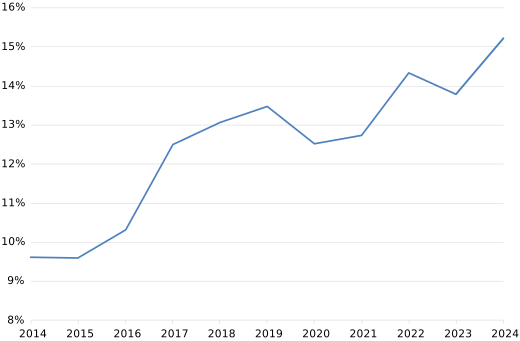
- Sources: Seafarer; Wind Information.22
Foreign countries offer Chinese firms new markets to sell products and potentially higher margins than the cutthroat domestic market. Goldman Sachs estimates that gross margins for the overseas business of Chinese firms are roughly 17% higher than domestic margins, and in some industries, such as semiconductors, autos, capital goods, and technology hardware, the difference is substantially larger.23
Responding to Chinese Competition
What should the world make of China’s growing dominance in a wide variety of industries? China’s rise reflects genuine firm-level competitiveness driven by entrepreneurs and managers seeking growth and profits. Firms within China compete fiercely with one another, and in the process, some become capable of competing globally. The size of China’s population and the scale of its economy magnify its impact on the global markets. It would be a mistake to explain away the country’s economic success as the result of state planning and subsidies.
Yet it is also quite clear that China’s inroads into many global industries have been furthered by industrial policy. Across clean technology, heavy industry, strategic materials, and manufacturing, China’s rapid investment in productive capacity is reshaping global pricing, margins, and export market share. Large-scale spending and policy support have supercharged the development of many Chinese companies. In a growing number of cases, industrial policy has driven supply well ahead of demand, pushing industries into overcapacity and financial instability. This has led Chinese companies to push aggressively into global markets out of necessity to maintain growth and profitability. The result is that global demand functions as a release valve for domestic imbalances.
The rest of the world must decide how to respond to the challenge presented by China’s economic disruption. For industries and companies affected by Chinese competition, this can mean a fight for market share, and sometimes survival, against new competitors. Can the incumbent companies in global industries improve their competitiveness quickly enough to retain their position?
For governments, the calculus hinges on both economic security and national security. Countries must decide what trade restrictions are needed to prevent domestic industries, especially those important for defense, from being overrun by Chinese competition. Many governments around the world are increasingly using industrial policy, mirroring some of China’s own strategies, to prevent their firms from being displaced.
The combination of intense domestic competition, scale, and industrial policy in China creates globally competitive firms, but it also produces overcapacity that spills outward as exports. China’s continued reliance on industrial policy and its inability to resolve domestic imbalances are reshaping global markets. In response, governments around the world are embracing industrial policy and raising trade barriers, leading to an increasingly fragmented global trading system.
Nicholas Borst,- The views and information discussed in this commentary are as of the date of publication, are subject to change, and may not reflect Seafarer’s current views. The views expressed represent an assessment of market conditions at a specific point in time, are opinions only and should not be relied upon as investment advice regarding a particular investment or markets in general. Such information does not constitute a recommendation to buy or sell specific securities or investment vehicles. It should not be assumed that any investment will be profitable or will equal the performance of the portfolios or any securities or any sectors mentioned herein. The subject matter contained herein has been derived from several sources believed to be reliable and accurate at the time of compilation. Seafarer does not accept any liability for losses either direct or consequential caused by the use of this information.
- As of December 31, 2025, the Seafarer Funds did not own shares in the securities referenced in this commentary.
- Relative to the size of its economy, China’s current trade surpluses are still below the astronomical highs of the mid-2000s.
- China data includes exports for both mainland China and Hong Kong. Exports from Hong Kong to mainland China have been removed from Hong Kong’s total. “Trade Map.” International Trade Centre, Accessed January 3, 2026. HS Codes for Electric and Plug-In Vehicles (HS 870360, HS 870370, 870380), Solar Panels (HS 854140, HS 854142, HS 854143), Batteries (HS 8507), Wind Turbines (HS 850231).
- “Special Report on Solar PV Global Supply Chains.” International Energy Agency, August, 2022.
- China data includes exports for both mainland China and Hong Kong. Exports from Hong Kong to mainland China have been removed from Hong Kong’s total. “Trade Map.” International Trade Centre, Accessed January 3, 2026. HS Codes for Port Machinery (HS 8426), Ships and Vessels (HS 89), and Construction Equipment (HS 8429).
- “Ships Built by Country of Building, Annual (Analytical).” United Nations Conference on Trade and Development (UNCTAD) Data Hub, Accessed January 6, 2026.
- China data includes exports for both mainland China and Hong Kong. Exports from Hong Kong to mainland China have been removed from Hong Kong’s total. “Trade Map.” International Trade Centre, Accessed January 3, 2026. HS Codes for Steel (HS 7210, HS 7207, HS 7208), Magnets (HS 8505), and Antibiotics (HS 2941).
- Graham, Niels. “Pharmaceuticals Are China’s Next Trade Weapon.” Atlantic Council, November 7, 2025.
- “2025 Facts and Figures of the European Chemical Industry.” European Chemical Industry Council, December 2, 2025.
- China data includes exports for both mainland China and Hong Kong. Exports from Hong Kong to mainland China have been removed from Hong Kong’s total. “Trade Map.” International Trade Centre, Accessed January 3, 2026. HS Codes for Industrial Robots (HS 847950), Air Conditioners and Heat Pumps (HS 8415), High-End Medical Equipment (HS 901813, HS 901812, HS 902212), and Laser Machine Tools (HS 845611).
- Kasahara, Shigehisa. “The Asian Developmental State and the Flying Geese Paradigm.” United Nations Conference on Trade and Development, November, 2013.
- Brodzicki, Tomasz. “On Flying Geese and Technological Convergence - the Evolution of Export Specialization in the East Asia Region.” S&P Global, July 14, 2021.
- According to the 2024 United Nations Conference on Trade and Development (UNCTAD) “Merchandise: Product Concentration and Diversification Indices of Exports.”
- “Taiwan’s Semiconductor Manufacturing Industry and Its Role in the International Supply Chain.” Institute for Security and Development Policy, February 10, 2025.
- “World Economic Outlook: Global Economy in Flux, Prospects Remain Dim.” International Monetary Fund, October, 2025.
- Boullenois, Camille, Malcolm Black, and Daniel Rosen. “Was Made in China 2025 Successful?.” Rhodium Group, May 5, 2025.
- “习近平:纵深推进全国统一大市场建设.” Ministry of Justice of the People’s Republic of China, September 15, 2025.
- Seafarer’s calculations using data from Damodaran, Aswath. “Data Library.” NYU Stern School of Business, January, 2026.
- “深刻认识和综合整治“内卷式”竞争.” Qiushi (Seeking Truth), July 1, 2025.
- Shaw, Vincent. “China Moves to Curb Solar Overcapacity, Stabilize Pricing.” PV Magazine, July 7, 2025.
- Xin, He. “Year in Review: Toxic Competition Drives China to Rein in Auto Price War.” Caixin Global, January 2, 2026.
- “Chinese Overcapacity Is Crushing the Global Steel Industry..” The Economist, September 17, 2024.
- Data as of December 24, 2025.
- Lau, Kinger, Timothy Moe, Si Fu, and Kevin Wang. “China Strategy - 10 Equity Lessons Learned from 2025.” Goldman Sachs, December 21, 2025.
![[Chrome]](/_layout/images/ua/chrome.png)
![[Firefox]](/_layout/images/ua/firefox.png)
![[Opera]](/_layout/images/ua/opera.png)
![[Microsoft Edge]](/_layout/images/ua/edge.png)