
- The much-publicized "asset famine," in which too much money chases too few assets in China’s financial markets, is also reflected in the real economy.
- The asset famine is linked to two structural conditions: financial repression and state control over important industries.
- The excessive investment and losses associated with asset famines will continue until more of the Chinese economy is opened to private investment.
Prevailing Winds is a China-focused blog written by Nicholas Borst, Vice President and Director of China Research at Seafarer. The blog tracks the economic and financial developments shaping the world’s largest emerging market.
A strange phenomenon lies at the heart of the Chinese economy: the much-discussed “asset famine” (资产荒). Amid the country’s economic slowdown, there are too few safe and attractive investment opportunities. China’s enormous pool of savings is largely trapped within its own borders due to capital controls. Together, these two factors create intense competition for the limited investment opportunities that remain.
One of the clearest signs of the asset famine has been in the bond market. Investors have crowded into the limited supply of low-risk government debt, driving bond yields to historically low levels. Slow growth and deflation pushed yields down, but the scramble for safe assets drove them even lower. As shown in Figure 1, the yield on Chinese government bonds has fallen dramatically, declining from around 4% in early 2018 to a record low of approximately 1.6% in early 2025, before recovering modestly to around 1.75% today. Investor demand for government bonds became so intense in 2024 that even the People’s Bank of China acknowledged the lack of safe assets was contributing to the decline in long-term yields.1
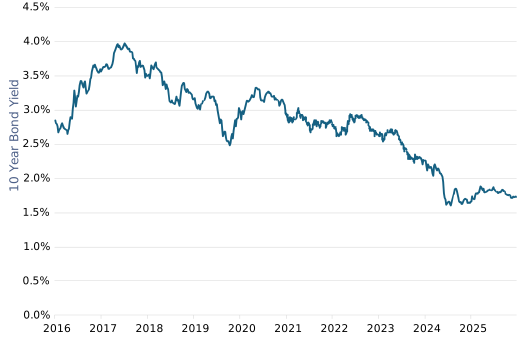
- Source: Bloomberg.
The asset famine phenomenon is not limited to China’s financial markets. The same pressures – too much capital chasing too few assets – can erupt into the real economy. When an attractive investment opportunity emerges, capital rushes in like a flood. Too much money pours into the industry, leading to overinvestment, excess supply, and ultimately poor returns. By competing so aggressively for scarce, high-quality assets, investors end up depressing returns across the entire industry, often laying the groundwork for long-term capital destruction. Understanding how and why these cycles occur in the real economy reveals some of the most important structural distortions in the Chinese economy.
Oceans of Capital and Walled-Off Valleys of Investment
The asset famine in the real economy is tightly linked to two structural conditions: financial repression and the government’s continued control over many important industries.
China has an enormous pool of capital available for investment, driven by the country’s exceptionally high savings rate. As a result, households and corporations hold trillions of dollars in savings that need to be invested. Figure 2 compares the savings rate as a share of GDP in China and the United States. As the chart shows, China’s savings rate is around 2.5 times higher.
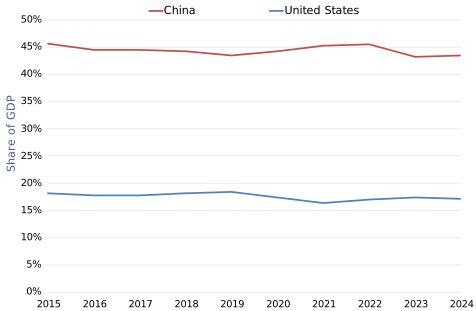
- Source: World Bank.
Such a high savings rate would be difficult to invest productively under any circumstances, especially now that the Chinese economy is no longer growing rapidly. The problem is compounded by capital controls, which keep much of these savings trapped within China’s borders. Except through narrow and tightly controlled windows permitted by the Chinese government, these savings cannot legally flow abroad in search of higher returns and greater diversification. At the same time, bank deposits offer only meager interest rates, while China’s relatively underdeveloped financial system remains dominated by state-owned banks rather than capital markets. The result is an enormous pool of capital competing for a limited supply of attractive domestic investment opportunities.
The second structural factor is that, compared with many advanced economies, private capital in China has access to a narrower range of investment opportunities. Many industries remain dominated by state-owned enterprises, with formal or informal restrictions limiting private investment. As discussed in What’s Wrong with Chinese Consumption?, these include oil and gas, shipping, defense, telecommunications, passenger aviation, rail transportation, education, utilities, healthcare, banking, and brokerage services. The collapse of the real estate market, which had long absorbed vast amounts of private capital, has further narrowed the set of available investment opportunities. The result is that private savings are increasingly concentrated in the remaining sectors open to investment, intensifying competition for assets.
Asset Famines in the Real Economy
Since the pandemic, weak consumer demand has made the asset famine more pronounced in the real economy. The asset famine follows a familiar pattern. Investors identify one of the few industries with growing demand, prompting a surge of investment that creates far more capacity than the market can absorb. As supply outstrips demand, firms compete aggressively on price to gain market share. The result is prolonged price wars that destroy profitability and force companies to absorb substantial losses in an effort to outlast their rivals.
This pattern has emerged across coffee, food delivery, e-commerce, express delivery, and community group buying. Coffee chains Luckin and Cotti battled fiercely on price, severely eroding their margins by discounting drinks, including premium beverages, to just 9.9 renminbi (RMB) (around $1.47) per cup.2 Starbucks steadily lost share to its lower-priced rivals and ultimately sold control of its China business in 2026. In food delivery, Alibaba, Meituan, and JD.com have offered substantial subsidies to undercut one another. JD.com entered the market in early 2025 with a 10 billion RMB ($1.48 billion) subsidy program, then Alibaba countered with a 50 billion RMB ($7.39 billion) subsidy plan for its instant retail platform.3 In the ensuing price war, Meituan swung from a 35.8 billion RMB ($5.29 billion) profit in 2024 to a 23.4 billion RMB ($3.46 billion) net loss in 2025.4 Similar competitive dynamics have emerged in e-commerce and express delivery.
The milk tea industry provides one of the clearest and most recent examples of this cycle. Capital poured into the industry, fueling an explosion of stores opened both directly by companies and by private franchisees. As shown in Figure 3, the number of stores operated by six major chains increased dramatically between 2021 and 2025. At the end of 2025, Mixue Ice Cream and Tea had 55,356 stores in China, more than McDonald’s 45,356 restaurants worldwide.5
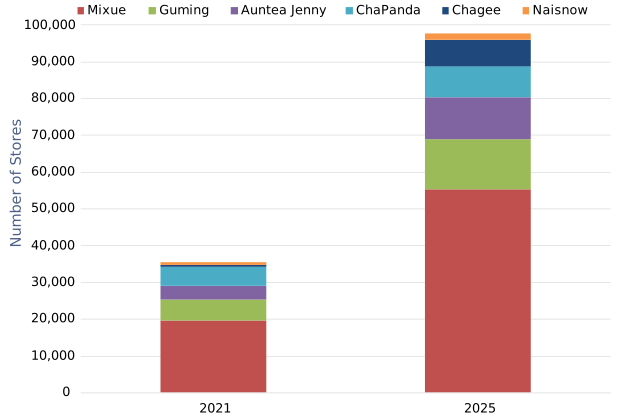
- Source: Company annual reports.67
The expansion was financed not only by franchisees but also by public markets. Between 2021 and 2025, the six major chains above went public, as noted in Figure 4, raising funds that supported further investment and expansion.
| Company | IPO Date |
| Naisnow | June 30, 2021 |
| ChaPanda | April 23, 2024 |
| Guming | February 12, 2025 |
| Mixue | March 3, 2025 |
| Chagee | April 17, 2025 |
| Auntea Jenny | May 8, 2025 |
- Source: Company filings.
This extraordinary expansion intensified competition, placing sustained downward pressure on prices and profitability across the industry. Too much competition has led to brutal pricing conflicts between milk tea franchises trying to capture customers. Many stores began pricing drinks at rock bottom levels, in some extreme cases as little as 2 RMB (30 cents) per cup.8 By one estimate, in some cities the market became so saturated that there can be 50 milk tea shops within less than a mile of each other.9 Even as tens of thousands of new stores were opening up, tens of thousands were closing down at the same time.10 Huge costs were endured by both the companies themselves, through payments of subsidies, and the individual franchise owners who were often operating at a loss.11
The impact of the milk tea price wars has been tough on shareholders so far. As shown in Figure 5, the stocks of these brands have all experienced a pronounced price decline over the past year.
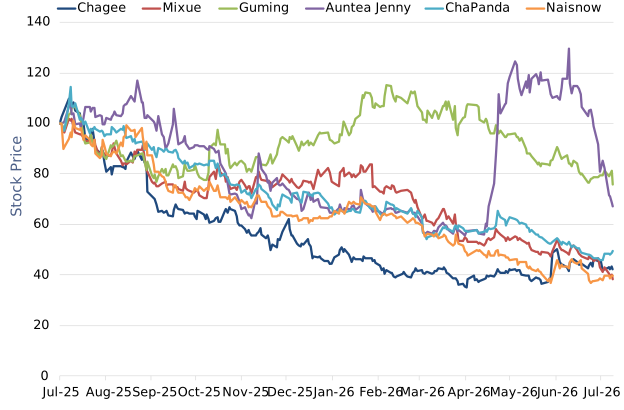
- Source: Bloomberg.
- Past performance does not guarantee future results.
Can the Asset Famine Be Prevented?
The cycle of price wars outlined above echoes the well-publicized “involution” problem plaguing many Chinese industries. In industries affected by involution, such as solar panels, batteries, and electric vehicles, overinvestment also led to excess supply and prolonged price wars. Yet there is an important difference. As I argued in Nobody Wins in a Price War: Destructive Competition in China, the core driver of involution in those industries is government industrial policy and subsidies that promote an industry, followed by government interference that prevents failing firms from shutting down.
The industries discussed in this piece differ because they are not the focus of industrial policy or extensive government subsidies. In general, the government has taken a more hands-off approach, allowing competition to play out with relatively limited intervention. In some cases, regulators have acted to curb what they view as predatory pricing, but they have also been willing to allow bankruptcies, sales, and restructuring. As a result, competition in these sectors can be just as intense as in industries targeted by government policy, but it tends to be shorter-lived because the private balance sheets funding the competition eventually run out of steam. Although the resulting price wars may look similar, they begin for different reasons and are sustained by different sources of capital.
The persistence of the asset famine is rooted in the structure of the Chinese economy. China’s large pools of private capital are concentrated in the limited parts of the economy open to private investment. When one of those sectors appears to offer growing demand, capital rushes in. The resulting investment may be rational for each company, investor, or lender, but in aggregate it often produces excess capacity, depressed returns, and wasted capital. There is no short-term solution because important formal and informal barriers continue to restrict private investment across large parts of the economy.
The long-term solution would require opening more of the Chinese economy to private investment, creating additional outlets for the country’s vast pool of private capital. In concrete terms, this could involve allowing greater private ownership and competition in state-controlled industries such as telecommunications, banking, air transportation, and utilities. At its most ambitious, it could also involve the privatization of some state-owned assets. Many of these assets could be managed more productively under private ownership. Such reforms could improve economic performance by increasing productivity, putting underutilized private capital to work, and generating revenue for the Chinese government to help meet its growing financial liabilities.
However, this type of economic transformation is currently close to politically impossible in China. Reducing the size and strength of state-owned firms runs counter to more than a decade of Chinese economic policy, which in practice has emphasized strengthening, rather than shrinking, the role of the state sector. As long as these barriers exist, episodes like the milk tea boom are likely to recur. The industries may change, but the underlying dynamics that produce these investment booms and busts will remain the same.
Nicholas Borst,- The views and information discussed in this commentary are as of the date of publication, are subject to change, and may not reflect Seafarer’s current views. The views expressed represent an assessment of market conditions at a specific point in time, are opinions only and should not be relied upon as investment advice regarding a particular investment or markets in general. Such information does not constitute a recommendation to buy or sell specific securities or investment vehicles. It should not be assumed that any investment will be profitable or will equal the performance of the portfolios or any securities or any sectors mentioned herein. The subject matter contained herein has been derived from several sources believed to be reliable and accurate at the time of compilation. Seafarer does not accept any liability for losses either direct or consequential caused by the use of this information.
- As of June 30, 2026, the Seafarer Funds did not own shares in the securities referenced in this commentary.
- “China Monetary Policy Report, 2024 Q1.” Monetary Policy Analysis Group of the People’s Bank of China, May 10, 2024.
- Wang, Keju. “End to Coffee Price War on Horizon.” China Daily, February 20, 2025.
- Cheng, Evelyn and Dylan Butts. “Coffee at 30 Cents Is the Latest Gimmick in China’s Billion-dollar ‘Instant Commerce’ Price War.” CNBC, July 11, 2025.
- Bao, Yunhuang. “Meituan Swings to $3 Billion Loss as Delivery Price War Bites.” Caixin Global, March 27, 2026.
- “MIXUE Group Annual Results Announcement for the Year Ended 31 December 2025.” March 24, 2026; “McDonald’s Corporation 2025 Annual Report.”
- Naisnow refers to Nayuki Holdings Limited, 2150 HK Equity; ChaPanda refers to Sichuan Baicha Baidao Industrial Co., Ltd., 2555 HK Equity; Guming refers to Guming Holdings Ltd., 1364 HK Equity; Mixue refers to MIXUE Group, 2097 HK Equity; Chagee refers to Chagee Holdings Limited, CHA US Equity; and Auntea Jenny refers to Auntea Jenny (Shanghai) Industrial Co., Ltd., 2589 HK Equity.
- Naisnow’s official filings do not provide a breakdown of mainland and overseas stores, but they indicate that the vast majority of its stores are in mainland China. The 2025 number of mainland stores is estimated based on media reports indicating that the company operated a small number of overseas stores in mid-2026. See Chang, Junping. "Naisnow Opens 50 Stores Nationwide as New Singapore Store Draws Long Queues: Domestic and Overseas Expansion Accelerates (奈雪全国连开50店,新加坡新店大排长龙 海内外双线加速)." Shenzhen News (深圳新闻网), May 27, 2026.
- “Mixue Profit Jumps 33% as Bubble-Tea Giant Defies Price War.” Bloomberg, March 24, 2026.
- Ren, Shuli. “Milk Tea Craze in Bringing Out All China’s Wrongs.” Bloomberg, July 8, 2024.
- Antoine and Hong Jun. “Nearly 200,000 Closures in a Year: Milk Tea Shops Have Become an Entrepreneurial ’Black Hole’ (一年倒闭近20万家, 奶茶店已成为创业"黑洞").” Hongcan (红餐网), December 11, 2024. Reprinted by CBNData (第一财经商业数据中心).
- Ren, Daniel. "China’s Tea-Drink Shops Thirst for Profits as Price Wars Dry Up Prospects." South China Morning Post, April 13, 2026.
![[Chrome]](/_layout/images/ua/chrome.png)
![[Firefox]](/_layout/images/ua/firefox.png)
![[Opera]](/_layout/images/ua/opera.png)
![[Microsoft Edge]](/_layout/images/ua/edge.png)