
During the fourth quarter of 2025, the Seafarer Overseas Value Fund returned 4.76%.12 The Fund’s benchmark indices, the Bloomberg Emerging Markets Large, Mid, and Small Cap Net Return USD Index and the Morningstar Emerging Markets Net Return USD Index, returned 3.22% and 4.14%, respectively. By way of broader comparison, the S&P 500 Index returned 2.65%.
The Fund began the quarter with a net asset value of $17.03 per share. During the quarter the Fund paid a distribution of approximately $0.857 per share. This payment brought the cumulative distribution, as measured from the Fund’s inception, to $3.896 per share.3 The Fund finished the period with a value of $16.98 per share.4
During the calendar year, the Fund returned 37.77%, whereas the benchmark indices, the Bloomberg Emerging Markets Large, Mid, and Small Cap Net Return USD Index and the Morningstar Emerging Markets Net Return USD Index, returned 28.78% and 29.76%, respectively.5
Please note: this Portfolio Review encompasses only the fourth quarter of 2025, and does not offer a thorough discussion of the entire calendar year. The Fund operates on a fiscal year that concludes April 30; as such, Seafarer offers performance review summaries for the Fund’s annual and semi-annual periods, which are published in the Fund’s Shareholder Reports in late June and December, respectively. Previous Shareholder Reports are available in the Archives.
Performance
The year 2025 proved to be remarkable for the Seafarer Overseas Value Fund not only due to the absolute and relative performance it delivered, but also because of how the Fund delivered it. While the performance examination below relates to the fourth quarter of 2025, the drivers of return are equally applicable to the calendar year.
Indeed, the Bloomberg EM benchmark’s primary drivers for the fourth quarter and full year of 2025 are the same and easily understood by reference to the term: artificial intelligence (AI). Three stocks accounted for the great majority (74.8%) of the benchmark’s return in the fourth quarter: Taiwan Semiconductor Manufacturing Company (TSMC), Samsung Electronics, and SK Hynix.
While the benchmark’s performance was concentrated in a narrow set of stocks that share the common denominator of supplying the artificial intelligence industry with hardware, the Value Fund’s drivers were mostly unrelated to AI and more diversified by sector and region.
To synthesize the quarter’s performance using financial parlance: sustained positive earnings revisions related to AI explained the benchmark’s performance, whereas capital return and recycling, valuation, and indirect exposure to AI explain the Value Fund’s returns.
To express the same idea using Value Fund terminology: Breakup Value, Asset Productivity, Management Change, and Segregated Market explain the Fund’s performance.
Capital return was the dominant force propelling the share price of top performance contributors: Georgia Capital (Breakup Value and Segregated Market; the “source of value” for a Fund holding is hereafter referenced in parentheses), a conglomerate in the Republic of Georgia; and Lion Finance (Asset Productivity and Segregated Market), one of the two largest banks in the Republic of Georgia. Whereas Georgia Capital repurchased and cancelled approximately 11.6% of its shares outstanding during 2025, Lion Finance did the same for approximately 2% of its shares outstanding, in addition to paying a dividend that yielded circa 4% during the year as of December 31, 2025 (or a 7.7% realized dividend yield based on its share price on December 31, 2024). The low valuation of both companies at the beginning of 2025 (0.5x price to book value (P/BV) for Georgia Capital and 1.0x P/BV for Lion Finance), together with their return of capital to shareholders, explains their share price appreciation during the year and fourth quarter.
Capital recycling, or the selling of unproductive assets to refocus management more productively and liquify the balance sheet6, propelled the share price of Hongkong Land (Breakup Value and Management Change) and DFI Retail (Management Change and Asset Productivity). The former announced during the fourth quarter the creation of a Singapore private real estate fund to manage its existing properties in the country and use it as a platform to grow over time. This announcement followed the earlier sale of a developer subsidiary with a portion of the proceeds allocated to the company’s share buyback program. DFI Retail also announced several divestments earlier in the year, including a special dividend during the third quarter that equated to a 14% yield at the time, which was paid in October. In December, the company held an investor day that outlined its plan to further enhance its capital efficiency, growth, and capital returns over the next three years.
Even though the Value Fund did not own any of the top contributors to the benchmark’s performance, it nevertheless benefitted from the surge in earnings expectations related to AI. The share price of Fund holding Samsung C&T (Breakup Value), a South Korean construction and engineering company and the de facto holding company for the Samsung Group, appreciated during the quarter driven by its 6.7% stake in Samsung Electronics. The latter’s share price surged due to renewed optimism regarding future orders for memory semiconductors. Another Fund holding in South Korea, Samsung SDI (Breakup Value and Structural Shift), a battery maker for electric vehicles (EVs) and consumer electronics, appreciated significantly on the expectation that it will repurpose battery production capacity from EVs to ESS (energy storage systems) to power AI servers.
Detractors to the Fund’s performance – there always are – tended to coalesce around the idea of postponed growth expectations. This was particularly the case for Brazilian holding XP, Inc. (Structural Shift), an investment management platform, whose share price declined on the delayed expectation for sustained interest rate cuts in the country, relating to shifts in the political landscape ahead of the country’s October 2026 presidential election. Along a similar vein, Mondi (Structural Shift), a multinational paper and packaging company with a large presence in Eastern Europe, suffered from poor quarterly results and soft guidance by management. Lastly, the case of Melco International (Asset Productivity and Deleveraging), a Macau casino owner and operator, was different. Macau visitation and spending trends continued to recover; however, the stock declined in the fourth quarter after very strong performance in the prior quarter. Market sentiment for the stock in the third quarter may have outpaced the improvement in its fundamentals, which the market corrected in the fourth quarter.
Allocation
The Fund did not exit any stocks during the fourth quarter, but it did establish positions in several new holdings.
Suzano (Asset Productivity and Deleveraging) is a Brazilian pulp and paper company whose hardwood pulp production capacity represents about 30% of the world’s non-integrated capacity.7 The Value Fund is essentially purchasing a world-class asset base that is very difficult to replicate due to geographic and climate related conditions, which make Suzano one of the lowest cost producers of hardwood pulp globally. The downturn in the pulp and paper industry has given the Fund the opportunity to buy this asset base at an attractive valuation, considering Suzano’s ability to generate positive cash flow during this phase of the cycle. The company’s announced joint venture with Kimberly Clark’s international paper subsidiary, which is expected to close in 2026, also may enhance Suzano’s future earnings prospects.
HDFC Bank (Asset Productivity and Structural Shift) is India’s largest private sector bank. The bank merged with its parent company in 2023, which added scale and expanded its customer base, but resulted in a deterioration of financial metrics and higher technology investments. The bank is now emerging from this transitional period. We expect HDFC Bank to improve its financial performance, normalize technology investments, and benefit from the maturation of its branch network after a period of aggressive expansion.
Finally, existing Fund holding Tata Motors (Asset Productivity and Breakup Value), an India-based auto manufacturer, spun-out its commercial vehicle subsidiary into a newly-listed entity. As such, the Value Fund now holds Tata Motors Passenger Vehicles Limited and Tata Motors Limited, which manufactures commercial vehicles.
Outlook
2025 was a year to be invested, not a year to hold strong views. The one lesson I take home from the experience of 2025 is the wisdom of remaining invested – in any security or market of one’s choice – for the right reasons that relate to fundamentals and not based on macro prognostications about the future.
Who could have predicted at the beginning of the year that 2025 would be the year when the Bloomberg Emerging Markets Index would post a substantial 28.78% total return and beat the S&P 500’s annual return after a decade of relative underperformance. Who could have anticipated that the imposition of tariffs by the United States on virtually all its trading partners would fail to provoke an earnings recession in the mercantilist emerging markets. Who could have predicted that the severe downturn in the Chinese real estate sector would not lead that economy into recession. Who could have guessed that a rise in the risk-free rate (a rise in the risk associated with the U.S. dollar and a concomitant increase in the yield of U.S. Treasuries) would fail to increase the risk premium associated with emerging market equities – a riskier asset class – and that EM markets would post their second highest annual total return since the 2008 Global Financial Crisis. The traditional and strongly held view by most investors that “when the U.S. sneezes the emerging markets catch a cold” proved wrong in 2025.
With the benefit of hindsight, of course, one can rationalize price action during 2025 with perfectly sound economic theory. Said explanations are not the focus of this commentary. In my view, a more valuable insight than ex-post rationalizations is that financial forecasts prove incorrect more often than not. That is a lesson I have validated every single year of my career in the context of company earnings projections. It was interesting to see it validated in 2025 in such an obvious manner and at a global scale. That is why this Outlook section started with the statement that 2025 proved to be a year to remain invested in EM, not a year to base decisions on forecasts. Asset allocators take note!
What then, would have constituted valid reasons to remain invested in EM at the beginning of 2025? In my view, based on experience, those reasons would have related to the positioning of fundamentals over forecasts. The earnings base (or starting point of absolute earnings) is as important a consideration as the growth forecast itself. The valuation base (or the valuation at the time of purchase) is as powerful a driver of investment returns as rising multiples. Admittedly, these are the important considerations to a value-minded investor. The discussion below will examine the fundamentals driving returns for the Bloomberg EM index and the Value Fund during 2025. I hope that framing the discussion around these fundamental considerations will help the reader better understand the perplexing performance of emerging market equities during 2025.
- As of January 16, 2026.
- The “Benchmark Bloomberg EM Index” refers to the Bloomberg Emerging Markets Large, Mid, and Small Cap Net Return USD Index (EMLSN).
- Return for the period 12/31/24 – 12/31/25: EMLSN = 28.8%.
- Past performance does not guarantee future results. Data is based on estimates and is unaudited; investors are cautioned not to rely on this data.
- It is not possible to invest directly in an index.
- Sources: Bloomberg; Seafarer.
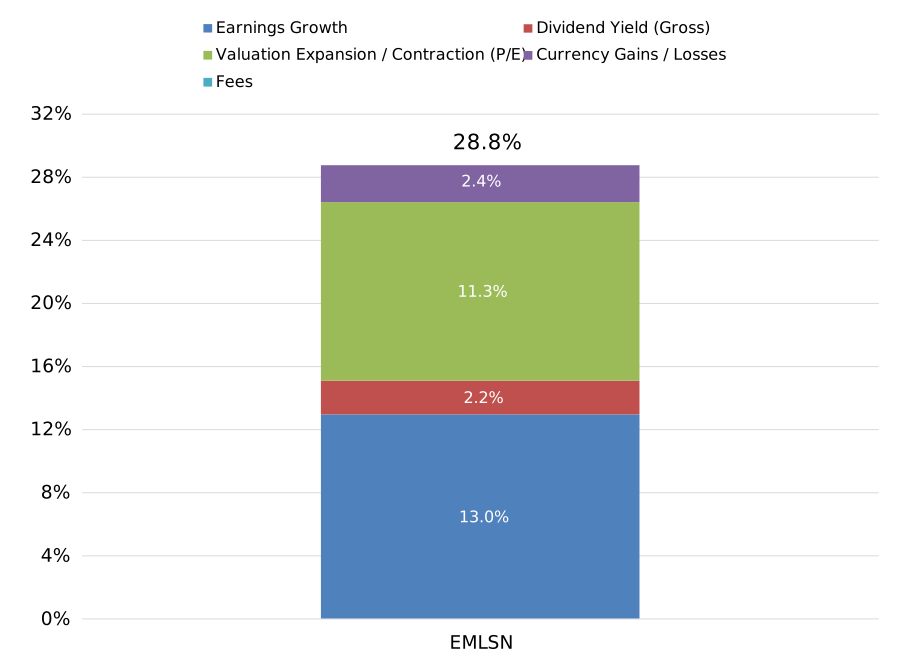
Figure 1 above decomposes the Bloomberg index’s 2025 total return into its constituent drivers. Please note that the chart is based on information available as of the date of writing, that not all EM corporates have reported full-year earnings yet, and that these figures will likely change over the coming months as more financial reports become available. In essence, these figures represent estimates. That said, the first salient point is that both earnings and multiple expansion (price to earnings (P/E) ratio) drove the index’s return concurrently, something that does not always happen. This is an indicator that a powerful force – other than tariffs and the Chinese economy – drove returns.
That force proved to be artificial intelligence. Based on available data as of the date of writing, Seafarer estimates that the information technology sector accounted for over 60% of the market’s 13.0% earnings growth (see Figure 1). On the other hand, China’s earnings are estimated to have grown a modest 2% during the year.
While it may be tempting to dismiss the 2025 EM equity performance as simply a derivative of the AI thematic, I would argue that there was more to it than that. Indeed, Chinese earnings did not implode with the combined impact of tariffs and a moribund real estate sector. Furthermore, Seafarer estimates that emerging market earnings growth excluding the twin impact of the information technology sector and China was in the order of 4%. In the context of the cloudy outlook for EM corporates at the beginning of the year, these figures are indicative of an overall earnings resilience, rather than earnings dependence on AI exclusively.
It is notable that 2026 consensus EM earnings growth expectations stand at 18% as of the date of writing.8 In the context of the past decade, 2017 and 2018 were the only occurrence of two consecutive years of earnings growth in the emerging markets. Only time will tell whether the projected growth for 2026 materializes. As of the date of writing, however, Seafarer’s assessment is that this growth estimate is qualitatively significant, and consistent with the 2025 earnings resiliency previously noted.
If EM earnings growth over the past year proved more resilient and widespread than generally anticipated by macro-based considerations, I would argue that the Bloomberg benchmark’s multiple-expansion of 11.3% (refer to Figure 1 above) was probably more narrowly explained by the ever-rising earnings growth expectations for AI-related companies. Not only were earnings associated with AI an island of greater security in a sea of tariff-related uncertainty, but they benefitted from positive and sustained earnings revisions as the year progressed, as evidenced by the experience of companies such as TMSC and Samsung Electronics. This is a powerful combination of factors to drive multiple expansion. The implication of this observation is that it is reasonable to expect that the index’s 28.78% total return for 2025 has probably lifted the valuation of emerging market corporates falling outside the AI thematic much less than for technology stocks within it. One should keep this idea in mind when weighing the value on offer by the EM universe after a year of strong returns.
The same way that one should not reduce the performance of emerging markets to an extension of the AI-thematic, one should not simplify the performance of individual funds during 2025 to their relative exposure to technology-related stocks.
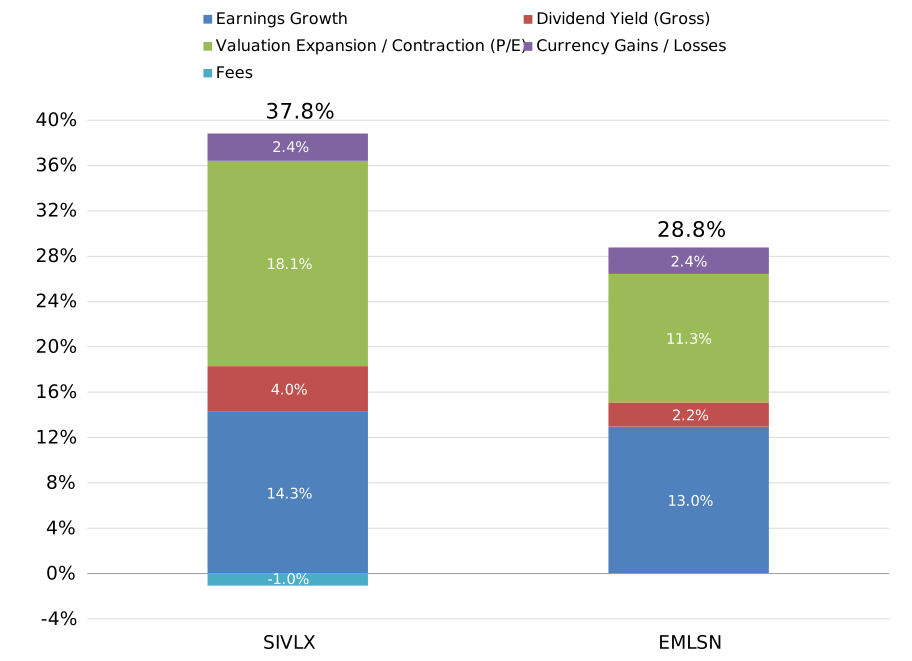
Figure 2 below adds the Seafarer Overseas Value Fund to the total return decomposition shown earlier. The reason for delving into a brief contrast of how the Value Fund generated returns versus the Bloomberg index is important, as it demonstrates that, at least for the year 2025, being invested for the right fundamental reasons not only generated attractive returns, but returns that rivaled those of the more AI-focused index and growth funds.
It is remarkable that in the absence of a value cycle (arguably, growth stocks drove market returns during 2025), the Value Fund generated attractive and competitive returns. If one should not dismiss earnings growth in the EM ex-AI universe, the experience of 2025 also indicates that one should not dismiss value strategies in the EM, or to associate their relative performance as dependent on value versus growth market cycles.
- As of January 16, 2026.
- The “Benchmark Bloomberg EM Index” refers to the Bloomberg Emerging Markets Large, Mid, and Small Cap Net Return USD Index (EMLSN).
- Return for the period 12/31/24 – 12/31/25: Seafarer Overseas Value Fund Institutional Class (SIVLX) = 37.8% and EMLSN = 28.8%.
- 30-Day SEC Yield for the Seafarer Overseas Value Fund: SIVLX 2.26%; SFVLX 2.14%; SFVRX 1.94% (12/31/25).
- Past performance does not guarantee future results. Data is based on estimates and is unaudited; investors are cautioned not to rely on this data.
- It is not possible to invest directly in an index.
- Sources: ALPS Fund Services, Inc.; Bloomberg; Seafarer.
To look at Figure 2 above and conclude that the Value Fund owned higher growth companies, whose valuation expanded more, and paid higher dividends, would be to arrive at the wrong conclusion. In fact, almost everything in the preceding statement is wrong.
Yes, in the aggregate, Fund holdings delivered more growth than the index, but generally speaking, that figure was predominantly driven by: (1) company-specific earnings turnarounds, as is the case with Fund holdings Hongkong Land and DFI Retail, not superior organic growth across the board; and (2) meaningful stock buybacks that boosted earnings growth per share the year in which said shares were canceled, as is the case with Fund holdings Georgia Capital, Lion Finance, and Jardine Matheson. The nature of this earnings per share (EPS) growth was very different from that of the market, which depended on accelerating revenue growth expectations for a specific industry.
Similarly, the nature of the Value Fund’s valuation expansion differed from that of the market in meaningful ways. The Fund’s multiple expansion was driven by a set of unrelated stocks whose multiple expanded for reasons specific to each company, such as management changes and operational turnarounds at DFI Retail and Hongkong Land, or a strategic repositioning at Samsung SDI. The nature of the benchmark’s valuation expansion related mostly to a specific set of companies and a common underlying driver: ever-rising expectations about future AI expenditure.
Finally, the Value Fund’s higher dividend yield is the corollary of what is probably lower organic growth than the Bloomberg index. The Fund aims to generate a total return from sources other than simply growth, with current income as one part of that strategy, as explained in the Seven Sources of Value framework.
The point of the foregoing differentiations is more than an intellectual exercise. The pragmatic implication is that by pursuing company-specific risk over market risk or beta, the Value Fund seeks to provide a source of return that is less correlated to the Bloomberg index than average, which may prove accretive within an EM allocation. To drive the point back to the start of this commentary, I would argue that the Value Fund’s strategy relies less on future growth forecasts to generate returns and more on the existing fundamental basis of an investment.
In conclusion, the performance that emerging markets delivered in 2025 was more than a derivative of AI-related earnings. In my view, EM corporates demonstrated earnings resilience and moderate growth outside of the technology sector and China. For the EM index, the outlook for 2026 seems to hinge on whether EM corporates deliver a meaningful measure of the 18% earnings growth currently projected by consensus. Spreading said growth more widely beyond AI-related corporates to other sectors would increase confidence in the sustainability of future positive returns for the asset class. In my opinion, this will be a critical factor to watch. Said growth, I suspect, will matter less to the success of the holdings in the Value Fund as articulated above.
I hope the foregoing observations will help investors weighing their approach to the emerging markets after a remarkable year. Similarly, I hope the insights into the inner workings of the Value Fund will help investors better understand the strategy.
Thank you for entrusting us with your capital. We are honored to serve as your investment adviser in the emerging markets.
Paul Espinosa,- The performance data quoted represents past performance and does not guarantee future results. Future returns may be lower or higher. The investment return and principal value will fluctuate so that an investor's shares, when redeemed, may be worth more or less than the original cost. View the Fund’s most recent month-end performance.
- The views and information discussed in this commentary are as of the date of publication, are subject to change, and may not reflect Seafarer’s current views. The views expressed represent an assessment of market conditions at a specific point in time, are opinions only and should not be relied upon as investment advice regarding a particular investment or markets in general. Such information does not constitute a recommendation to buy or sell specific securities or investment vehicles. It should not be assumed that any investment will be profitable or will equal the performance of the portfolios or any securities or any sectors mentioned herein. The subject matter contained herein has been derived from several sources believed to be reliable and accurate at the time of compilation. Seafarer does not accept any liability for losses either direct or consequential caused by the use of this information.
- As of December 31, 2025, securities mentioned in the portfolio review comprised the following weights in the Seafarer Overseas Value Fund: Georgia Capital PLC (4.1%), Lion Finance PLC (4.1%), Hongkong Land Holdings, Ltd. (3.9%), DFI Retail Group Holdings, Ltd. (3.4%), Samsung C&T Corp. (3.0%), Samsung C&T Corp. Pfd. (0.1%), Samsung SDI Co., Ltd. (2.6%), XP, Inc. ADR (2.1%), Mondi PLC (2.2%), Melco International Development, Ltd. (3.3%), Suzano SA ADR (1.9%), HDFC Bank, Ltd. (2.0%), Tata Motors Limited (0.3%), Tata Motors Passenger Vehicles Limited (0.3%), and Jardine Matheson Holdings, Ltd. (3.4). The Fund did not own shares in Taiwan Semiconductor Manufacturing Company, Samsung Electronics, SK Hynix, or Kimberly Clark. View the Fund’s Top 10 Holdings. Holdings are subject to change.
- Sources: ALPS Fund Services, Inc. and Bloomberg.
- Source: Bloomberg Index Services Limited. BLOOMBERG® is a trademark and service mark of Bloomberg Finance L.P. and its affiliates (collectively “Bloomberg”). Bloomberg or Bloomberg’s licensors own all proprietary rights in the Bloomberg Indices. Neither Bloomberg nor Bloomberg’s licensors approves or endorses this material, or guarantees the accuracy or completeness of any information herein, or makes any warranty, express or implied, as to the results to be obtained therefrom and, to the maximum extent allowed by law, neither shall have any liability or responsibility for injury or damages arising in connection therewith.
- The Seafarer Funds are not sponsored, endorsed, sold, or promoted by Morningstar, Inc. Morningstar, Inc. makes no representation or warranty, express or implied, to the shareholders of the Funds or any member of the public regarding the advisability of investing in the Funds or the ability of the Morningstar Emerging Markets Net Return U.S. Dollar Index to track general equity market performance of emerging markets.
- References to the “Fund” pertain to the Fund’s Institutional share class (ticker: SIVLX). The Investor share class (ticker: SFVLX) returned 4.71% during the quarter. The Retail share class (ticker: SFVRX) returned 4.65% during the quarter. All returns are measured inclusive of Fund distributions paid (in relation to Fund performance) or dividends paid (in relation to index performance), reinvested in full (exclusive of any U.S. taxation) on the pertinent ex-date.
- The performance data quoted represents past performance and does not guarantee future results. Future returns may be lower or higher. The investment return and principal value will fluctuate so that an investor’s shares, when redeemed, may be worth more or less than the original cost. View the Fund’s most recent month-end performance.
- The inception date of the Fund’s Institutional share class is May 31, 2016.
- The Fund’s Investor share class began the quarter with a net asset value of $16.95 per share; it paid a distribution of approximately $0.846 per share during the quarter, and it finished the quarter with a value of $16.90 per share. The Fund’s Retail share class began the quarter with a net asset value of $16.92 per share; it paid a distribution of approximately $0.825 per share during the quarter, and it finished the quarter with a value of $16.88 per share.
- The Fund’s Investor share class returned 37.48% during the calendar year. The Fund’s Retail share class returned 37.27% during the calendar year.
- To liquify a balance sheet is to convert non-cash assets into cash or cash equivalents.
- Non-integrated pulp and paper refers to manufacturing facilities that either produce only pulp or only paper/paperboard, but not both at the same location.
- Source: J.P. Morgan, “Emerging Markets Equity Strategy,” January 2, 2026.
![[Chrome]](/_layout/images/ua/chrome.png)
![[Firefox]](/_layout/images/ua/firefox.png)
![[Opera]](/_layout/images/ua/opera.png)
![[Microsoft Edge]](/_layout/images/ua/edge.png)